Survey Methods ·
Questionnaire Reliability and Validity Analysis: A Practical Research Workflow
A practical questionnaire workflow that separates internal consistency, dimensionality, and validity evidence using reliability analysis, EFA, CFA, and transparent reporting.
Questionnaire reliability and validity analysis should not be reduced to one Cronbach's alpha. Internal consistency asks whether items behave coherently under a scoring model. Dimensionality asks how many constructs the items represent. Validity concerns whether evidence supports the intended interpretation and use of scores. A strong workflow keeps these questions separate and connects each claim to appropriate evidence.
ChatSRS — AI Statistics currently registers dedicated analyzers for reliability, validity/exploratory factor analysis (EFA), principal component analysis, and confirmatory factor analysis (CFA). Those analyzers can support parts of the workflow described here. They do not prove that a questionnaire is valid, choose a construct theory, or remove the need for design and measurement judgment.
Who this workflow is for
This guide is for researchers with multi-item questionnaire data and an explicit construct map. It fits scale development, adaptation, pilot testing, or evaluation when item wording, coding, sample, and intended score use are documented.
It is not enough for a clinical diagnostic instrument, high-stakes selection test, cross-cultural equivalence claim, or other use requiring specialist validation without additional evidence. Translation quality, content coverage, response processes, criterion relations, fairness, invariance, and external replication may all matter beyond the registered analyses named here.
Reliability, dimensionality, and validity are different
Reliability
Reliability concerns consistency or precision. Cronbach's alpha is one internal-consistency coefficient. It depends on the covariance among items and assumptions about how items relate to the construct. A high alpha does not establish a single factor, accurate measurement, or validity. It can increase when many similar or redundant items are included.
Dimensionality
Dimensionality concerns the latent structure: whether items reflect one factor, several correlated factors, or another structure. EFA explores patterns when the structure is not firmly specified. CFA evaluates a prespecified factor model. PCA is a component-reduction method and should not be described as interchangeable with a latent-factor model without justification.
Validity
Validity is an argument supported by multiple sources of evidence about score interpretation and use. Factor structure can contribute to internal-structure evidence. It is not the entire validity argument. Content experts, response-process studies, relations with external variables, predictive or concurrent evidence, group comparability, and consequences of use may also be necessary.
Step 1: Write the construct and scoring map
Before calculating anything, list:
- each construct and its definition;
- items intended for each construct;
- response range and anchors;
- reverse-keyed items and the approved recoding rule;
- planned sum or mean score;
- rules for missing item responses;
- the population and intended use;
- whether EFA, CFA, or both are confirmatory or exploratory in this study.
Do not let the observed alpha decide which construct an item was meant to measure. Theory and item content come first.
Step 2: Audit coding and item distributions
Confirm that item columns are numeric and use the intended direction. Recode reverse-keyed items before computing scale scores, but keep original columns and document the new variables. Verify missing codes, skipped items, impossible values, floor or ceiling concentration, and sparse response categories.
Inspect counts and distributions item by item. An item with almost no variation can contribute little information even if the total alpha appears acceptable. A mislabeled missing code can inflate variance and correlations.
A reproducible input example
Suppose study_habits_scale.xlsx contains 12 already scored items for three hypothesized factors:
- Focus:
focus_1–focus_4 - Planning:
plan_1–plan_4 - Persistence:
persist_1–persist_4
The reverse-keyed source items have already been recoded into separate, audited analysis columns. A one-sentence request could be:
In
study_habits_scale.xlsx, audit the 12 scored item columns, response range, missingness, and item distributions. For each prespecified four-item factor, report Cronbach's alpha, corrected item-total correlations, alpha if each item is deleted, and observations used. Then evaluate dimensionality: use EFA only if this sample is designated exploratory, report KMO, Bartlett's test, factor-retention reasoning, rotated loadings, communalities, and explained variance. Use the current ChatSRS CFA only when treating the indicators as numeric/continuous is defensible and ML, GLS, or WLS matches the approved plan; report convergence, standardized loadings, fit indices, AVE, CR, and factor correlations. For ordered categorical indicators requiringordered=or WLSMV, stop and use a specialist workflow. Do not call alpha validity or treat a cutoff as automatic acceptance.
This prompt does not ask the system to invent the scale structure. It supplies the structure and asks for traceable evidence.
Step 3: Review reliability output
The current ChatSRS reliability analyzer calculates Cronbach's alpha. Its simple output reports dimension, item count, analyzed sample size, and alpha. Detailed mode replaces that table with item means, standard deviations, corrected item-total correlations, alpha after deleting each item, and the dimension alpha; it does not display item count or analyzed sample size. Save a separate simple run, or an independently audited complete-case record tied to the same scored columns, for those fields. It supports item groupings supplied as dimensions.
Review the output in this order:
- Confirm the intended items were matched to each dimension.
- Confirm item direction and numeric coding.
- Check the number of complete observations used.
- Read alpha with uncertainty and context rather than a universal pass/fail threshold.
- Inspect corrected item-total correlations for items that behave differently.
- Inspect “alpha if deleted” as a diagnostic, not an instruction to delete automatically.
- Revisit item content before changing the scale.
Deleting an item solely because alpha rises can narrow construct coverage or capitalize on sampling noise. Record both the statistical evidence and the substantive reason for any revision.
A worked example: catching a weak item with CITC
The review order above is easiest to see on a real table. Below is one construct from a run on simulated survey data (N = 300, 20 items across five constructs) — demo data, not a live analysis for this article.
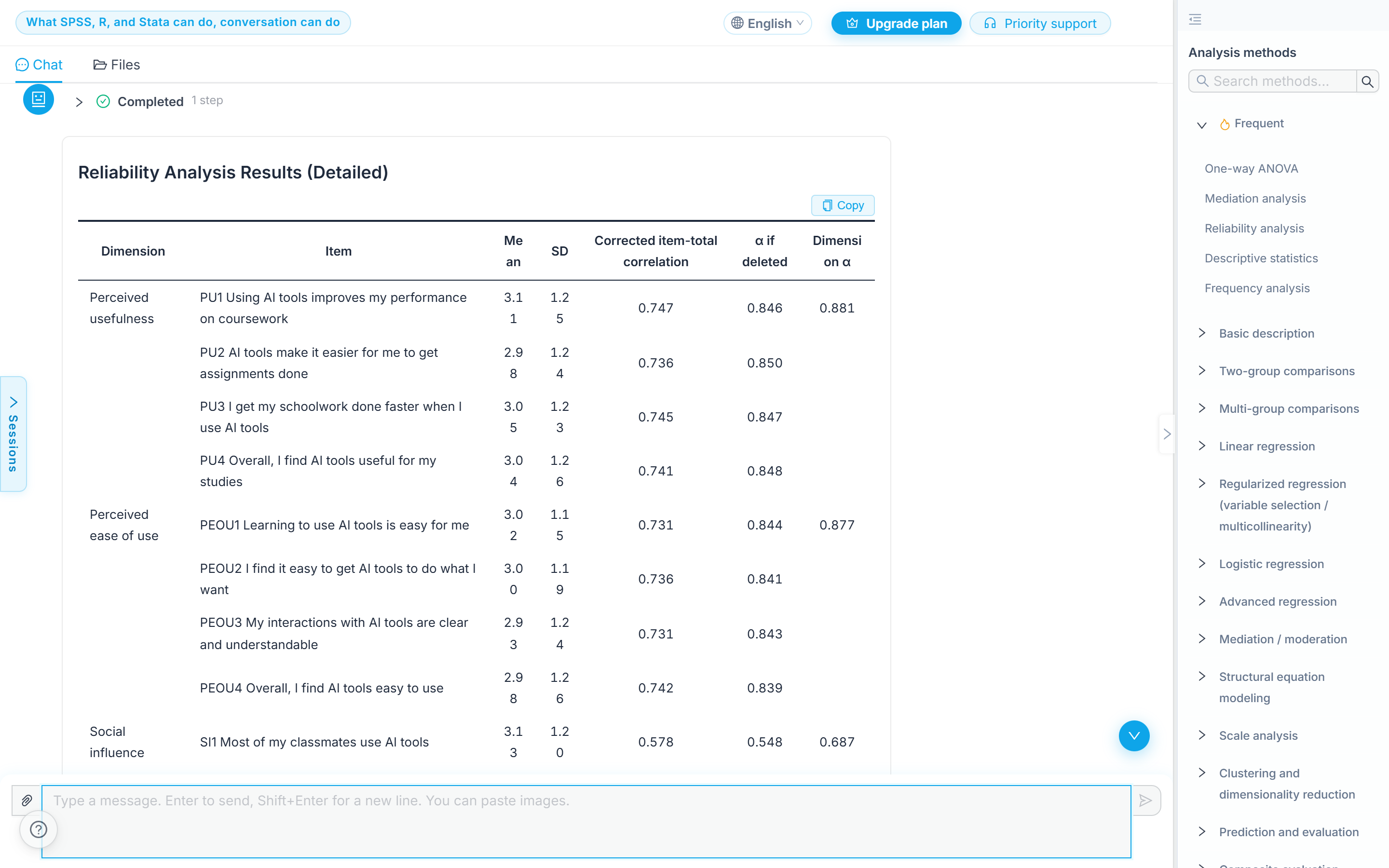 The chat interface behind the run below.
The Social Influence (SI) construct, four items, returned a dimension alpha of .687:
| Item | Mean | SD | Corrected item-total correlation | α if deleted |
|---|---|---|---|---|
| SI1 — Most of my classmates use AI tools | 3.13 | 1.20 | .578 | .548 |
| SI2 — My professors encourage the use of AI tools | 3.20 | 1.16 | .600 | .536 |
| SI3 — Seeing people around me use AI tools makes me want to try them too | 3.26 | 1.18 | .533 | .581 |
| SI4 — My department has an official policy requiring us to use AI tools | 3.11 | 1.16 | .207 | .774 |
Dimension α = .687 (4 items, N = 300)
Source: ChatSRS detailed reliability output on simulated survey data, N = 300, Social Influence construct (chatsrs-en-results.md, 03-reliability run).
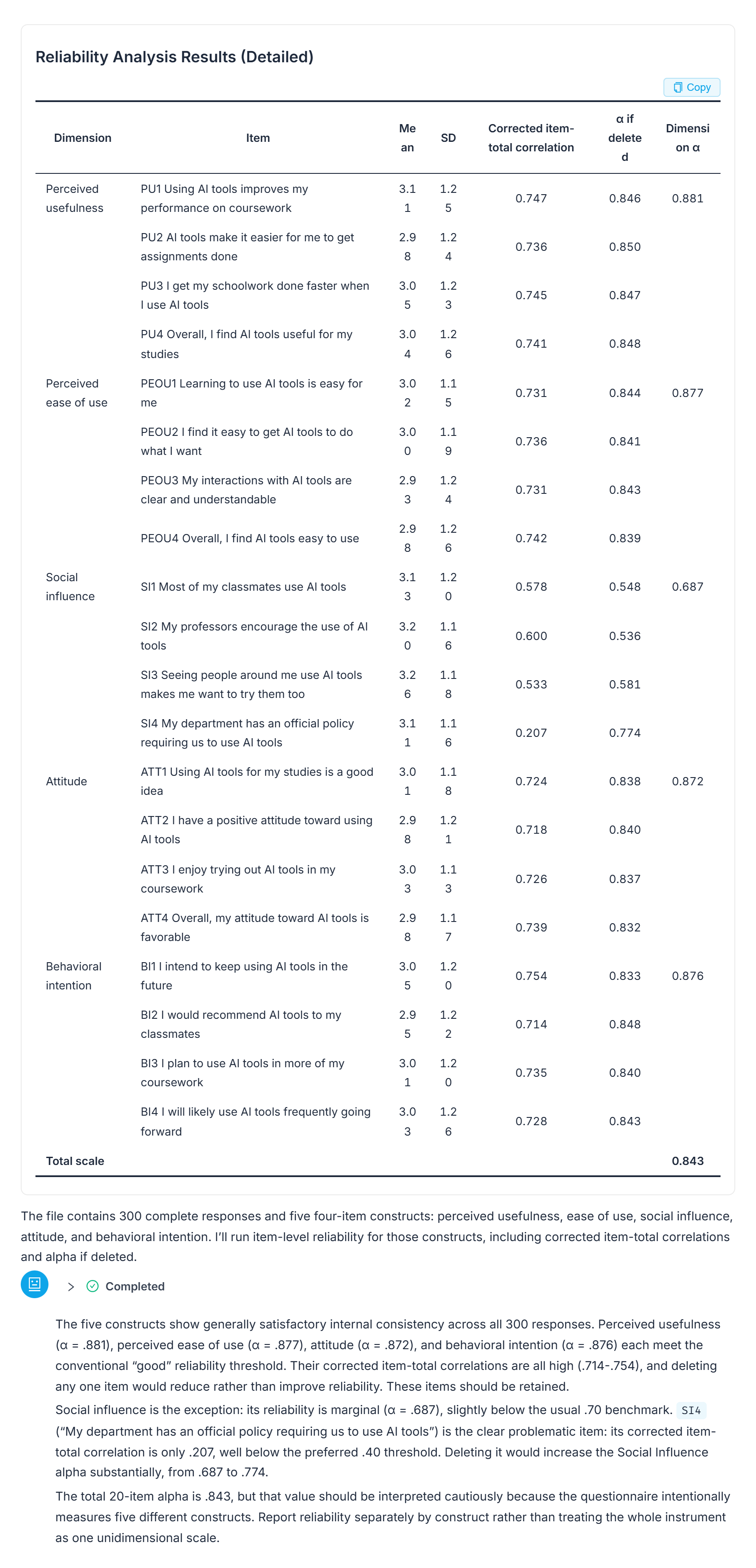 The output panel behind the table above — SI4's low corrected item-total correlation and the alpha-if-deleted figure are both visible in the same screenshot.
SI1 through SI3 sit between .533 and .600 — comfortably above the common .30 reference point named in Step 3. SI4 is the outlier, at .207. Read against item content, that gap makes sense: SI4 asks about an institutional mandate ("my department has an official policy requiring us to use AI tools"), while SI1–SI3 ask about the people around the respondent — a different idea, which is consistent with the weak correlation. The "alpha if deleted" column already shows what removing SI4 would do to this dimension: alpha would rise from .687 to .774. No rerun is needed to see this — it is the same output, read one column over.
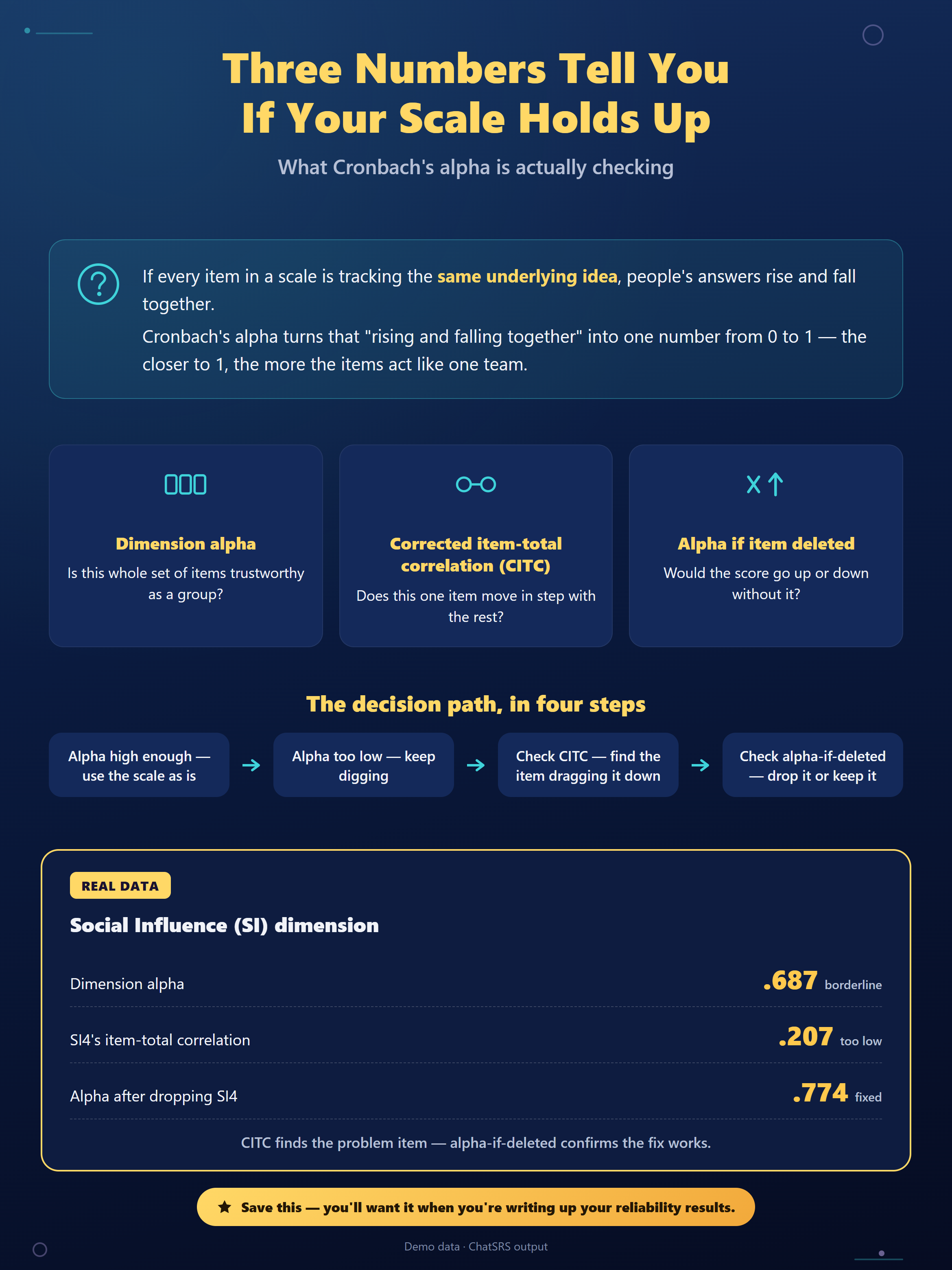 A map of the same decision path applied to the SI4 pattern above.
This is also why "alpha if deleted" is described above as a diagnostic rather than an instruction: dropping SI4 here would be defensible only because a content-level reason — a mismatched item, not an arbitrary search for the largest alpha gain — backs the CITC pattern.
Step 4: Decide whether EFA is appropriate
EFA is useful when the structure is genuinely exploratory or when an adaptation needs structural investigation. Do not run EFA merely because it appears in a standard checklist.
The registered ChatSRS validity analyzer implements an EFA workflow that includes KMO, Bartlett's test, factor extraction, Varimax rotation when more than one factor is retained, eigenvalue/variance information, loadings, and communalities. The analyzer requires at least three valid numeric variables and checks for sufficient usable rows at execution. Its default factor-retention behavior is a computational starting point, not a complete psychometric decision rule.
When reviewing EFA:
- evaluate whether the correlation matrix is appropriate;
- treat KMO and Bartlett as diagnostics, not proof of validity;
- justify the extraction and rotation choices;
- use theory, scree/parallel-analysis evidence where available, interpretability, and replication—not eigenvalues alone—to decide factor count;
- inspect primary loadings, cross-loadings, communalities, and factor meaning;
- avoid naming factors from numbers alone.
If correlated constructs are expected, an oblique rotation may be scientifically preferable. Verify the exact analyzer options rather than assuming every rotation is implemented.
Step 5: Use CFA for a prespecified model
CFA tests whether a specified measurement model is consistent with the observed covariance structure under its assumptions. The current ChatSRS CFA analyzer accepts an explicit factor-to-item mapping and uses an R/lavaan execution path. Its formatted output includes standardized loadings, fit measures, AVE, CR, factor correlations, and sample size when the analysis converges.
The current implementation is not an ordered-indicator CFA path. Its estimator validation allows ML, GLS, or WLS, and the generated lavaan::cfa() call does not pass an ordered= argument. WLS here must not be described as WLSMV or as proof that ordinal item thresholds were modeled. When Likert or other ordered categorical indicators require an ordinal CFA estimator such as WLSMV, use a specialist implementation and preserve that output separately.
Before CFA, state:
- which items load on which factors;
- whether cross-loadings or correlated residuals are allowed and why;
- estimator and indicator treatment; the current analyzer cannot implement
ordered=/WLSMV for ordinal indicators; - missing-data approach;
- identification constraints;
- planned fit assessment;
- whether the CFA sample is independent of the EFA sample.
Do not modify the model repeatedly until fit becomes acceptable without recording and validating the changes. Data-driven modifications can overfit one sample.
Step 6: Interpret validity evidence conservatively
An acceptable CFA fit does not prove the questionnaire is valid. Use precise language:
- “The three-factor structure was supported in this sample under the specified model” is bounded.
- “The questionnaire is valid” is usually too broad.
- AVE and factor correlations can inform convergent and discriminant structure, but should not be treated as the only evidence.
- Criterion relationships require appropriate external variables and a design that supports the claimed interpretation.
- Group comparisons may require measurement-invariance analysis before mean differences are interpreted.
If the required evidence is outside the registered analyzers, use a specialist workflow rather than forcing a conclusion.
How to inspect an illustrative output
Imagine—not as a live run—that the Planning dimension has alpha = .78 and one item has a corrected item-total correlation of .24. That pattern is a reason to inspect the item's wording, coding, and construct fit. It is not an automatic deletion rule.
Imagine a CFA where a standardized loading is weak while the overall fit is mixed. Do not hide the weak item behind a global index. Report the model, estimator, loadings, uncertainty, fit indices, sample, and any prespecified comparison. If the model was revised, separate the original and revised results and seek replication.
Every prose claim should map to a specific output field or non-statistical evidence source.
Common failure modes
“Alpha above a threshold means valid”
False. Alpha concerns internal consistency, not content, dimensionality, criterion relations, or score-use validity.
“Alpha rises if deleted, so remove the item”
Incomplete. Check content coverage, reverse coding, distribution, and replication before changing the instrument.
“KMO is acceptable, so the factor model is correct”
False. KMO concerns sampling adequacy for factor analysis; it does not choose or validate the substantive model.
“EFA found three factors, so CFA is unnecessary”
False. EFA and CFA answer different questions. Confirmatory claims ideally require a prespecified model and new evidence.
“Good CFA fit proves the scale works everywhere”
False. Evidence may not generalize across populations, languages, contexts, or uses.
“Selecting WLS means the current CFA handled ordinal items with WLSMV”
False. The current analyzer permits an estimator label WLS, but its generated cfa() call has no ordered= argument and does not implement an ordered-indicator WLSMV workflow. Use a specialist tool when the measurement plan requires it.
Reporting checklist
Report:
- sample and missing-data handling;
- item wording/coding and reverse-scoring process;
- factor assignment and score construction;
- reliability coefficient, item count, and analyzed N;
- item diagnostics when relevant;
- EFA extraction, rotation, factor-retention reasoning, loadings, and variance;
- CFA estimator, indicator treatment, model specification, standardized loadings, fit, AVE/CR where used, and model changes; identify a separate specialist path for ordered indicators requiring WLSMV;
- limitations and evidence not evaluated.
Do not copy analyzer-generated prose without checking it against the tables and the instrument documentation.
Reproducibility package
Archive the questionnaire version, scoring key, codebook, original and recoded columns, analysis request, dimension/factor mapping, analyzer and options, raw output, model revisions, and final report. If EFA and CFA use split samples, preserve the split rule and random seed.
For the broader questionnaire pipeline, read How to Analyze Survey Data Online Without SPSS. To organize data cleaning and reporting, use AI Data Analysis for Academic Research. For a tool-level comparison, see ChatSRS vs ChatGPT for Statistical Analysis.
Frequently asked questions
Does the detailed reliability table contain item count and analyzed N?
No. The detailed table contains item diagnostics and the dimension alpha. Save a separate simple run, or a verified complete-case record tied to the same scored columns, for item count and analyzed sample size.
Can alpha above a conventional threshold prove validity?
No. Alpha addresses internal consistency for a specified item set and sample. It does not establish dimensionality, content coverage, criterion evidence, fairness, or suitability for a particular score use.
Does selecting WLS in the current CFA path mean ordinal WLSMV was fitted?
No. The current generated cfa() call does not pass ordered= and should not be described as an ordered-indicator WLSMV workflow. Use a verified specialist implementation when that estimator is required.
Can I run EFA and claim confirmation from the same sample?
That reuses exploratory information and can overstate confirmation. Prespecify the CFA and, when feasible, use an independent sample or a documented split; otherwise describe the evidence as provisional and seek replication.
Bottom line
Reliability, dimensionality, and validity evidence are related but not interchangeable. Use alpha and item diagnostics for internal consistency, EFA for justified exploration, CFA for a specified model, and external evidence for the broader validity argument. Software can calculate and organize evidence; the researcher remains responsible for the claim.
Run a staged questionnaire evidence review in ChatSRS — supply the scoring key, construct map, item columns, and evidence you intend to evaluate.