Academic Reporting ·
Cronbach’s Alpha: How to Run, Interpret and Report It
A defensible guide to running, interpreting, and reporting Cronbach’s alpha with correct scoring, item diagnostics, sample accounting, and clear limits on reliability claims.
Cronbach’s alpha summarizes internal consistency for a specified set of scored items in a specified sample. A defensible analysis starts before the coefficient: confirm the instrument version, item membership, response coding, reverse-key rules, and missing-data plan. Then read alpha together with item diagnostics and construct coverage. Alpha does not prove that a scale is unidimensional, valid, unbiased, or suitable for every population.
ChatSRS — AI Statistics has a registered reliability analyzer that can calculate alpha for one item set or several prespecified dimensions. Its simple output reports dimension, item count, analyzed sample size, and alpha. Detailed mode produces a separate table with item mean, item standard deviation, corrected item-total correlation, alpha if deleted, and the dimension alpha; it replaces the simple table and does not repeat item count or analyzed sample size. Use a separate simple run or another verified analysis record for those two fields. These outputs support an evidence-led review; they do not turn a numerical threshold into an automatic keep-or-delete rule.
Define the scale before calculating reliability
Write an item map that identifies:
- the exact instrument and version;
- the construct and subscale assigned to every item;
- the stored response codes and displayed labels;
- which items are reverse-keyed according to the approved scoring source;
- which values mean missing, refused, or not applicable;
- whether a total score is theoretically intended;
- the population and occasion represented by the data.
Do not ask software to discover the scoring key from negative wording. A negatively phrased item is not automatically reverse-keyed, and two items with the same response range do not automatically belong to one scale. Preserve raw columns and create separately named scored columns so the transformation remains auditable.
A distinct working example
Suppose museum_access.xlsx contains six items intended to measure wayfinding clarity after a museum visit: way_1 through way_6. Responses range from 1 = strongly disagree to 5 = strongly agree. The approved manual marks only way_4 as reverse-keyed. Codes 8 and 9 represent not applicable and missing, respectively. The study plan treats all six scored items as one candidate scale but requires the researcher to review item content and dimensionality before using a total score.
A reproducible request is:
Audit
museum_access.xlsxagainst the supplied item map. Preserve all raw columns. Recode documented 8 and 9 values as missing in separate analysis columns, reverse onlyway_4under the approved 1–5 rule, and verify the resulting range. Run the simple reliability output for the six prespecified scored items to record dimension, item count, analyzed N, and Cronbach’s alpha. Run detailed output separately to record item means and SDs, corrected item-total correlations, alpha if each item is deleted, and the dimension alpha. Reconcile both runs to the same scored columns and complete-case rule. Do not ask the detailed table for N or item count, because it does not display them. Do not automatically remove an item, infer dimensionality, call alpha validity, or apply a universal cutoff. Show the missing-data notice and map every reporting sentence to its output or verified analysis record.
The prompt fixes the item set and scoring rules before the coefficient is seen.
How the current reliability workflow behaves
One dimension
When no dimension map is supplied, the selected columns are treated as one dimension. At least two valid numeric items and enough complete rows are required. The analyzer converts selected item values to numeric form and performs complete-case handling within that dimension. Text labels therefore need a verified numeric scoring representation before analysis.
Several dimensions
A dimension map can group items into named subscales in one call. The analyzer calculates each subscale separately. It can also produce a total-scale alpha across the combined dimensions, but that number is only substantively meaningful when the instrument defines an overall composite. Software output is not evidence that multidimensional content should be collapsed.
The effective N for each subscale can differ because complete cases are determined from that subscale’s items. A combined total can use a more restrictive set of complete rows. Record the N for each coefficient from the separate simple output or another audited complete-case record rather than copying one sample size across the table. The detailed table does not display N.
Simple and detailed output
The simple result contains each dimension’s item count, sample size, and alpha. Detailed mode is required for item means, standard deviations, corrected item-total correlations, and alpha if deleted, but it replaces rather than extends the simple table. The detailed table omits item count and sample size. Save both outputs for the same scored columns, or pair the detailed table with an independently verified complete-case record. The current formatter does not provide a confidence interval for alpha. If the research plan or venue requires one, obtain it from a verified method and identify that additional procedure; do not invent an interval from the point estimate.
Read alpha as a sample- and item-set statistic
Alpha depends on the number of items, their covariance pattern, scoring, sample heterogeneity, and the population represented. A larger coefficient can result from adding highly similar items, even when construct coverage becomes narrower. A lower coefficient can occur in a short scale designed to cover a broad domain. The same instrument can produce different values across populations or occasions.
Thresholds such as .70, .80, or .90 are conventions used differently across fields and purposes. They are not laws. State the decision context, cite the relevant methodological or instrument source, and examine uncertainty and item content. Avoid writing that a scale is “reliable” solely because a point estimate crosses one number.
A negative alpha is a warning, not a meaningful negative reliability score to interpret substantively. It can indicate reversed direction, coding errors, or strongly inconsistent covariance. Stop and audit the items before proceeding.
Interpret corrected item-total correlations carefully
The corrected item-total correlation relates one item to the sum of the other items in its assigned dimension. A weak or negative value can flag:
- an uncorrected reverse-keyed item;
- a mislabeled or wrongly coded variable;
- an item measuring different content;
- a restricted response distribution;
- a sample-specific pattern;
- a genuinely broad construct.
It does not by itself authorize deletion. Read the item wording, response distribution, theoretical role, and effect on content coverage. If an item is essential to the construct, removing it to improve a coefficient may weaken validity even when alpha rises.
Treat “alpha if deleted” as a diagnostic, not an instruction
Alpha if deleted answers a narrow counterfactual: what would the point estimate be in this sample if one item were removed? It does not show that removal will improve a new sample, preserve the construct, or solve dimensionality. Small changes may be sampling noise or item-count effects.
Before considering removal, document the reason, inspect the item map and distribution, and ask whether the item was prespecified. If the decision is exploratory, label it as such and validate the revised scale in independent data when possible. Never search through deletions only to maximize alpha and then present the final set as if it were planned in advance.
Alpha is not dimensionality or validity
Items from two correlated factors can yield a high alpha. Conversely, a coherent short scale can yield a modest alpha. Use a theoretically appropriate EFA or CFA workflow when the question concerns dimensionality. Validity requires evidence about interpretation and use, potentially including content, response process, relations to other variables, internal structure, and consequences. Alpha addresses none of those domains by itself.
For a broader distinction among reliability, EFA, CFA, and validity claims, see Questionnaire Reliability and Validity Analysis. For item coding and ordinal boundaries, use Likert Scale Analysis with AI.
Review the output in a fixed order
For the museum example, verify:
- the matched item list contains exactly
way_1throughway_6; - only
way_4was reversed and all scored values remain 1–5; - documented missing codes were excluded rather than interpreted as responses;
- analyzed N from the separate simple output or audited complete-case record matches the detailed run’s scored columns;
- item means and SDs reveal no impossible or nearly constant columns;
- alpha is tied to this item set and sample;
- corrected item-total values agree with item direction;
- alpha-if-deleted changes are interpreted with item content;
- no sentence claims unidimensionality or validity from alpha.
An illustrative alpha of .82 is not a live product result. It becomes reportable only after scoring, item membership, missingness, and sample are verified.
What the output actually looks like: a demo-data walkthrough
To make the fields above concrete rather than abstract, here is one full run on simulated survey data (N = 300, five constructs, 20 items) — not a live analysis for this article, but unedited output from the current analyzer.
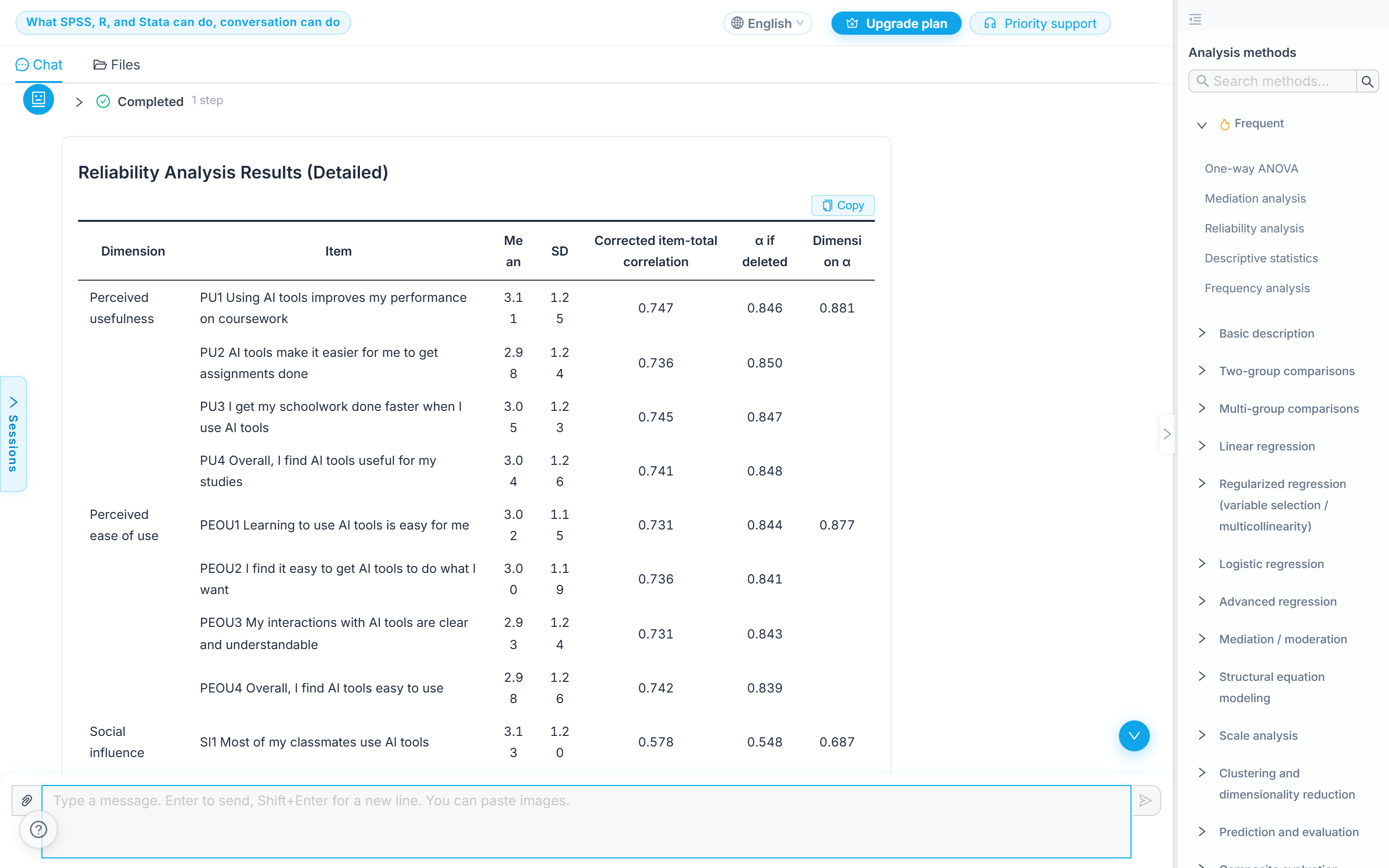 The chat interface used for the run below — reliability analysis sits alongside the other registered analyzers.
The request was one plain-English line: "This is a 5-construct survey — run a reliability analysis by dimension."
 The one-line request that produced the detailed table below — no menu selection or syntax involved.
Detailed mode returned item mean, SD, corrected item-total correlation, alpha if deleted, and each dimension's alpha:
| Dimension | Item | Mean | SD | Corrected item-total correlation | α if deleted | Dimension α |
|---|---|---|---|---|---|---|
| Perceived usefulness | PU1 — Using AI tools improves my performance on coursework | 3.11 | 1.25 | .747 | .846 | .881 |
| PU2 — AI tools make it easier for me to get assignments done | 2.98 | 1.24 | .736 | .850 | ||
| PU3 — I get my schoolwork done faster when I use AI tools | 3.05 | 1.23 | .745 | .847 | ||
| PU4 — Overall, I find AI tools useful for my studies | 3.04 | 1.26 | .741 | .848 | ||
| Perceived ease of use | PEOU1 — Learning to use AI tools is easy for me | 3.02 | 1.15 | .731 | .844 | .877 |
| PEOU2 — I find it easy to get AI tools to do what I want | 3.00 | 1.19 | .736 | .841 | ||
| PEOU3 — My interactions with AI tools are clear and understandable | 2.93 | 1.24 | .731 | .843 | ||
| PEOU4 — Overall, I find AI tools easy to use | 2.98 | 1.26 | .742 | .839 | ||
| Social influence | SI1 — Most of my classmates use AI tools | 3.13 | 1.20 | .578 | .548 | .687 |
| SI2 — My professors encourage the use of AI tools | 3.20 | 1.16 | .600 | .536 | ||
| SI3 — Seeing people around me use AI tools makes me want to try them too | 3.26 | 1.18 | .533 | .581 | ||
| SI4 — My department has an official policy requiring us to use AI tools | 3.11 | 1.16 | .207 | .774 | ||
| Attitude | ATT1 — Using AI tools for my studies is a good idea | 3.01 | 1.18 | .724 | .838 | .872 |
| ATT2 — I have a positive attitude toward using AI tools | 2.98 | 1.21 | .718 | .840 | ||
| ATT3 — I enjoy trying out AI tools in my coursework | 3.03 | 1.13 | .726 | .837 | ||
| ATT4 — Overall, my attitude toward AI tools is favorable | 2.98 | 1.17 | .739 | .832 | ||
| Behavioral intention | BI1 — I intend to keep using AI tools in the future | 3.05 | 1.20 | .754 | .833 | .876 |
| BI2 — I would recommend AI tools to my classmates | 2.95 | 1.22 | .714 | .848 | ||
| BI3 — I plan to use AI tools in more of my coursework | 3.01 | 1.20 | .735 | .840 | ||
| BI4 — I will likely use AI tools frequently going forward | 3.03 | 1.26 | .728 | .843 | ||
| Total scale | .843 |
Source: ChatSRS detailed reliability output on simulated survey data, N = 300 (chatsrs-en-results.md, 03-reliability run).
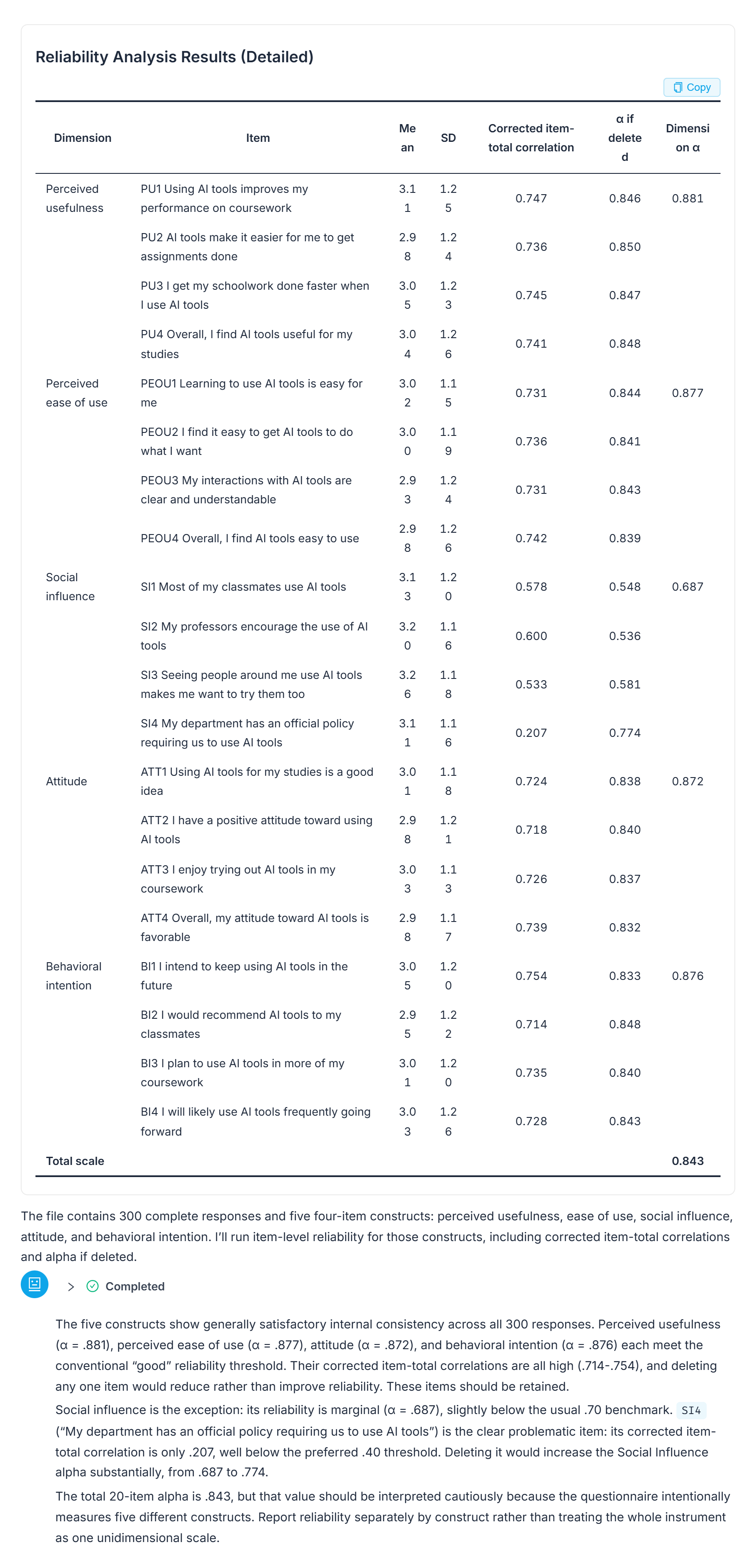 The output panel behind the table above — dimension alphas and item-level diagnostics in one unedited screenshot.
Four of the five dimensions land at α = .881 (perceived usefulness), .877 (perceived ease of use), .872 (attitude), and .876 (behavioral intention) — comfortably inside the conventional "good" range this guide describes above. The fifth, social influence, comes in at α = .687, with one item (SI4) showing a corrected item-total correlation of only .207 — well below the other items in its own dimension. Reading that gap, and deciding what (if anything) to do about it, is a full worked example in its own right; see Questionnaire Reliability and Validity Analysis for the item-by-item walkthrough on this same construct.
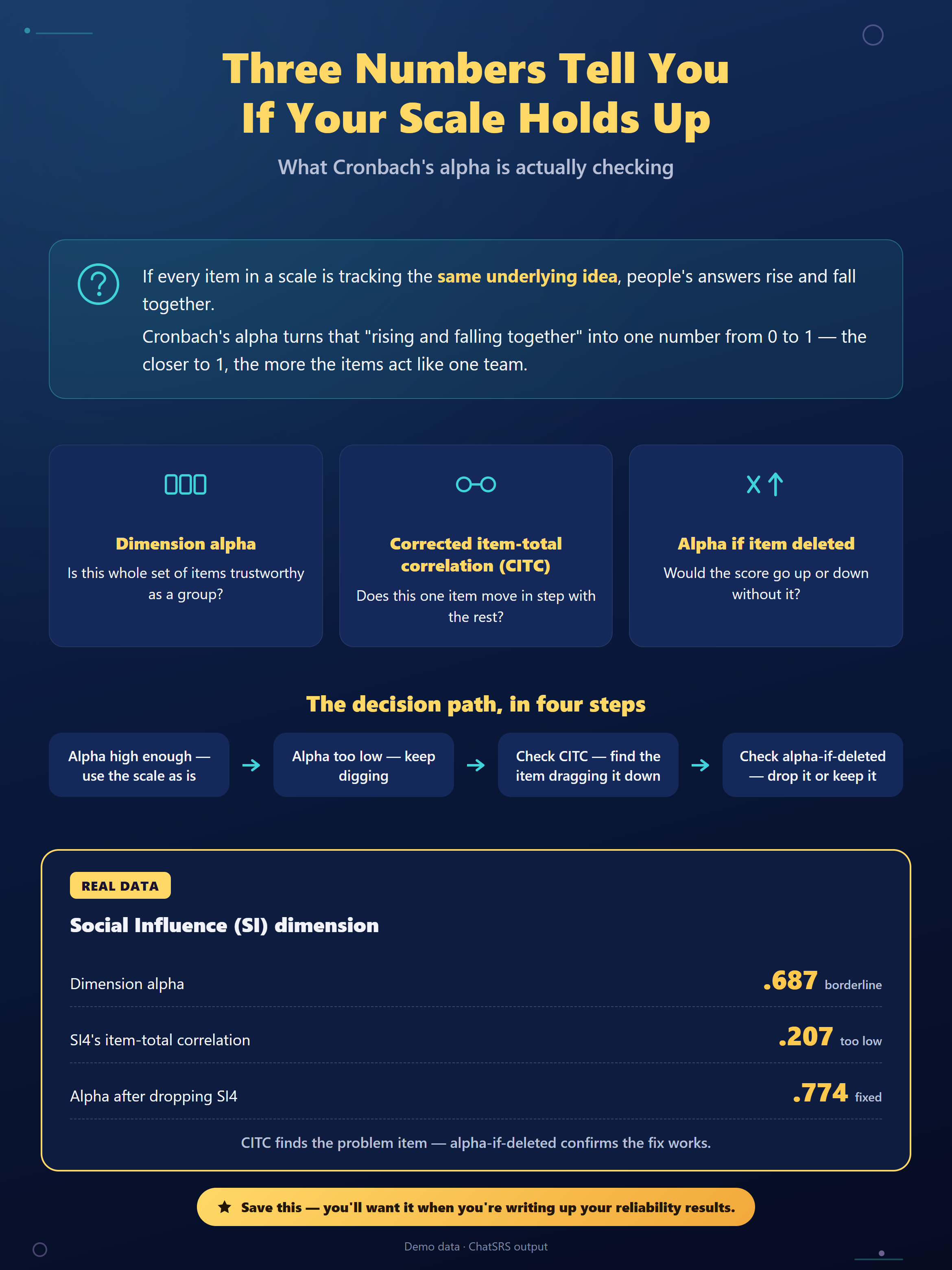 The decision path for a construct like the one above — not unpacked in this walkthrough; it's the subject of the linked example.
The total 20-item alpha from this run was .843, but consistent with the guidance above, that figure is not reported as a single scale score on its own — the instrument measures five separate constructs, and each is reported by dimension in the table.
A bounded reporting template
Adapt this language to the actual instrument and venue:
Internal consistency was evaluated for the prespecified six-item Wayfinding Clarity scale using complete observations for the scored items. After applying the documented reverse-key rule to
way_4, Cronbach’s alpha was α = [verified value] (N = [verified N from the separate simple output or audited complete-case record]). Corrected item-total correlations from the detailed output ranged from [verified minimum] to [verified maximum]. Item diagnostics were reviewed against the approved construct map; no item was removed solely to increase alpha. Alpha is reported as sample-specific internal-consistency evidence and is not treated as proof of unidimensionality or validity.
If an item was removed, report the decision timing, theoretical and empirical rationale, revised item count, exploratory status, and whether independent confirmation exists. Do not hide the original specification.
Common reporting errors
Reporting only “alpha was acceptable”
Give the coefficient, item count, analyzed N, scoring context, and interpretation boundary. “Acceptable” needs a stated criterion appropriate to the purpose.
Using the full dataset N
The reliability run may use fewer complete observations. Use N from the separate simple output or an audited complete-case record, reconcile it to the detailed run’s item set, and describe missing-data handling. Do not infer N from the detailed table.
Calling alpha a test of validity
Alpha is an internal-consistency statistic. It does not establish factor structure or validity.
Deleting every item that raises alpha
Deletion can narrow the construct and overfit the current sample. Review wording and theory first.
Combining subscales because software reports a total alpha
A generated total does not make a multidimensional instrument unidimensional. Report subscales according to the approved model.
Reproducibility package
Archive the instrument version, item map, raw-to-scored mapping, missing codes, selected columns, dimension map, exact analysis request, output, software/analyzer identity, analyzed N, item-level decision log, and final report. If scoring changes, create a new version instead of silently overwriting the old one.
For the wider evidence trail from data to manuscript, read AI Data Analysis for Academic Research.
Frequently asked questions
Does alpha above .70 prove a good scale?
No. It is one convention in some contexts, not universal proof. Review purpose, item count, uncertainty, content, dimensionality, and validity evidence.
Should I delete an item whenever alpha if deleted is higher?
No. Inspect coding, wording, construct coverage, prespecification, and the size of the change. An exploratory deletion needs transparent reporting and ideally independent validation.
Can alpha prove a scale is unidimensional?
No. Dimensionality requires a measurement model and appropriate evidence, not alpha alone.
Does ChatSRS currently output an alpha confidence interval?
The current reliability formatter reports the alpha point estimate and, in detailed mode, item diagnostics. It does not display an alpha confidence interval; use a separately verified method when one is required.
Does the detailed reliability table include item count and analyzed N?
No. Detailed mode replaces the simple table and omits those fields. Save a separate simple output for item count and analyzed sample size, or use another verified complete-case analysis record tied to the same scored columns.
Bottom line
Run Cronbach’s alpha only after fixing the item set and scoring rules. Report the point estimate with item count and analyzed N from the simple output or another verified analysis record, then add relevant diagnostics from the detailed output. Interpret alpha as sample-specific internal consistency. Keep decisions about dimensionality, validity, and item deletion separate and reviewable.
Run a bounded reliability workflow in ChatSRS — bring the item map, scoring key, missing codes, and prespecified dimensions.