Academic Reporting ·
How to Report ANOVA in APA 7: F, Degrees of Freedom and Effect Size
Report ANOVA in an APA-oriented format without inventing fields: verify design, group summaries, F, degrees of freedom, p, effect size source, post hoc results, and limitations.
An APA-oriented ANOVA report should identify the design and variables, describe the groups, report the omnibus F statistic with both degrees of freedom and p, provide an appropriate effect size from a verified source, explain planned follow-up comparisons, and state the relevant limitations. The report must match the analysis that actually ran. A polished template cannot supply a missing statistic or convert the wrong design into a valid one.
The current ChatSRS — AI Statistics one-way ANOVA output provides group mean ± SD, F, p, and df1/df2 in a note. When a requested LSD, Bonferroni, or Tukey HSD post hoc table is rendered, it adds pairwise group means, a labeled mean difference, standard error, p, and Cohen’s d. The current Tukey branch stores J−I in a column labeled I−J and gives d the same reversed sign, so those two signed Tukey fields are not safe reporting evidence until independently recomputed. The current main table does not display an omnibus eta squared or omega squared, and the formatted pairwise table does not display confidence intervals. If your venue requires missing or corrected fields, obtain them from a separately verified output source and preserve that provenance.
Begin the report with the exact design
“An ANOVA was conducted” is rarely enough. Name:
- whether the analysis is one-way, factorial, repeated-measures, mixed, or adjusted;
- the outcome and its units;
- the factor or factors and their levels;
- the observational unit and independence structure;
- the analyzed sample and missing-data rule;
- the planned omnibus and follow-up tests.
This guide’s current-product example concerns a classical one-way between-groups ANOVA. Do not reuse its wording for repeated observations, covariate adjustment, unequal-variance Welch ANOVA, or a factorial interaction.
A distinct reporting example
Suppose tutoring_trial.csv contains one row per independently assigned student. tutorial_format has three levels: workbook, live seminar, and guided practice. The outcome vocabulary_gain is the prespecified post-minus-pre score. The approved plan uses a one-way ANOVA and Tukey HSD follow-up if the omnibus result supports the planned all-pairs comparison.
A reporting request is:
Use only the verified final one-way ANOVA output for
vocabulary_gainbytutorial_format. Confirm the group labels, analyzed observations, group means and SDs, F, df1, df2, and p. If the requested Tukey table was rendered, extract the tested pair, standard error, and adjusted p value. Do not copy the visible I−J difference or Cohen’s d sign: recompute I−J from the displayed group means and obtain d from another verified calculation before writing higher/lower or a signed effect. If no such verification is available, report the pair and adjusted p without a directional claim. Do not invent an omnibus effect size, confidence interval, Levene statistic, Welch result, or residual diagnostic. Return an evidence map from each sentence to its verified source and mark all numerical examples as illustrative until replaced by the verified run.
The request prevents a reporting model from silently filling conventional fields that are absent.
Build the evidence table before writing prose
Create a small extraction record:
| Reporting element | Verified source |
|---|---|
| Outcome and units | Protocol and data dictionary |
| Group labels | Assignment record and matched data |
| Group M and SD | Current ANOVA main table |
| Omnibus F and p | Current ANOVA main table |
| df1 and df2 | Current ANOVA note |
| Effective observations | Missingness record and df reconciliation |
| Pair identity, SE, and p | Rendered post hoc table, if present |
| LSD/Bonferroni signed difference and d | Rendered table after checking I/J order |
| Tukey signed difference and d | Independent recomputation from group means and another verified effect-size source |
| Omnibus effect size | Separately verified output, if required |
| Assumption evidence | Separate diagnostic record |
If a source cell is empty, do not write the number. Either obtain an approved analysis that supplies it or say that the field was not available in the current result.
Report descriptive statistics with context
Group means and standard deviations help readers understand direction, magnitude, and overlap before the omnibus test. State units and group identities. Avoid presenting a mean difference as meaningful merely because one mean is numerically larger.
The current main table places group counts in headers and mean ± SD in cells. Outcome-specific missingness can reduce effective observations even when a group header shows the loaded group count. Reconcile missing-data notices and degrees of freedom before copying N into prose. If several outcomes were analyzed, each can have a different complete-case sample.
Format the omnibus result from verified fields
A conventional sentence structure is:
The one-way analysis of variance indicated [evidence/no evidence] of a difference in [outcome] among [groups], F([df1], [df2]) = [F], p = [p], [effect size symbol] = [effect size].
Use exact output values and the venue’s rounding rules. A value displayed as below a threshold should be reported as a bound, not as zero. Do not write “highly significant” as a substitute for magnitude and uncertainty.
An illustrative sentence—not a live result—is:
Vocabulary gain differed across the three tutorial formats, F(2, 87) = 6.14, p = .003, η² = .12.
The η² value above is deliberately illustrative and is not a field from the current ChatSRS one-way ANOVA table. It may be used only after a verified effect-size calculation tied to the same sums of squares, sample, and model. Never copy it into a real report.
Understand both degrees of freedom
For a classical one-way analysis, df1 reflects the between-group component and usually equals the number of analyzed groups minus one. df2 reflects the within-group error component. Confirm both against the group count and effective observations. A mismatch can reveal excluded rows, empty groups, or a report copied from another run.
Do not borrow df from a different model. Welch ANOVA, repeated-measures corrections, mixed models, and factorial effects have different df logic and reporting requirements.
Effect size requires a named, verified source
The omnibus p value addresses compatibility with equal population means under the model; it does not show practical magnitude. Report an effect size appropriate to the design and method, such as eta squared or omega squared when justified. Name the statistic and preserve the formula or output source.
The current ChatSRS one-way main table does not render omnibus eta squared or omega squared. Its post hoc table can render Cohen’s d for pairwise comparisons, although the current Tukey d sign follows J−I while the visible difference label says I−J. Verify or recompute that signed Tukey effect before reporting it. Pairwise d is not a replacement for the omnibus effect size: the two describe different quantities. If the manuscript requires both, obtain and verify each separately.
Avoid universal labels such as small, medium, or large without field context. Describe the outcome units and study relevance, and include uncertainty when the approved workflow provides it.
Report post hoc comparisons without reversing direction
An omnibus result does not identify which groups differ. If the planned post hoc table is available, name the method and correction. For LSD and Bonferroni, the signed difference follows group I minus group J and should still be checked against the displayed group order. The current Tukey branch is different: statsmodels supplies group J minus group I, but the renderer labels that value I−J and calculates d with the same reversed sign. If I = A has mean 1 and J = B has mean 3, true I−J is −2, while the current Tukey row may display +2 and a positive d. Do not use those visible signs in prose.
A bounded template is:
Tukey-adjusted comparisons tested guided practice against workbook instruction (SE = [verified SE], adjusted p = [verified p]). An independent calculation from the displayed group means confirmed I−J = [recomputed difference], and a separate verified calculation gave d = [verified signed d]; therefore, guided practice had [higher/lower] vocabulary gain. [If the signed fields were not independently verified, omit the direction, difference, and d and report only the pair and adjusted p.]
The formatter displays pairwise SE, p, and d, but not pairwise confidence bounds. For Tukey, pair identity and adjusted p remain usable, while the signed difference and d require the independent checks above. Do not add a confidence interval unless it comes from a verified source. If post hoc testing was requested but the current analyzer did not render a table because the omnibus p was not below .05, report that actual behavior and follow the prespecified plan.
LSD, Bonferroni, and Tukey answer different multiplicity choices. Do not switch methods after reading the results to recover significance.
Describe assumptions honestly
For the one-way model, discuss independence from the design, outcome and residual behavior, variance structure, influential observations, and missingness. The current ANOVA Markdown output does not display Levene’s test, residual plots, or a Welch alternative. Therefore, a sentence saying “all assumptions were met” cannot be sourced from that table alone.
Record the diagnostic workflow separately. If evidence supports a different method, report that method rather than retaining the classical result for convenience. Assumption checks should guide model adequacy, not become a ritual for deleting inconvenient observations.
Distinguish statistical evidence from the research claim
In a randomized experiment with correct implementation, a group contrast may support a causal treatment interpretation within the study’s scope. In an observational comparison, the same F test generally supports an association, not proof that group membership caused the outcome. State design, assignment, confounding limits, and generalizability.
A small p value does not prove a theory, and a large p value does not prove equality. Read effect magnitude, uncertainty, sample, design, and diagnostics together.
A full worked report, built from verified fields
The evidence-table habit above is easiest to see against a real table. Below is one full one-way ANOVA run on simulated survey data (N = 300), split low/medium/high by AI-tool usage frequency, 100 per group — demo data, not a live result for this article.
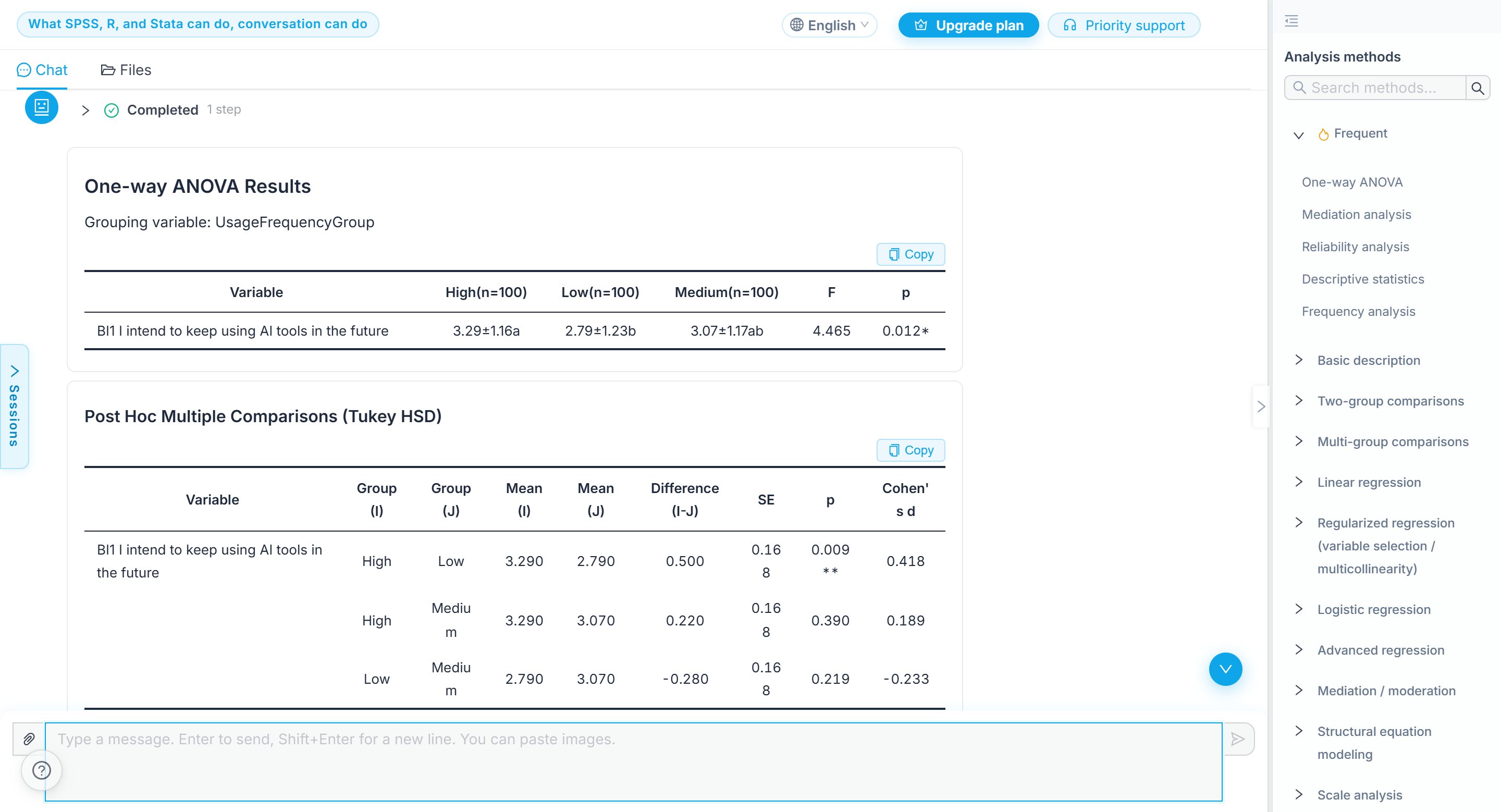 The chat interface behind the run below.
Omnibus test: F(2, 297) = 4.465, p = .012. Group means: low-frequency M = 2.79 (SD = 1.23), medium-frequency M = 3.07 (SD = 1.17), high-frequency M = 3.29 (SD = 1.16) — increasing in step with usage frequency.
Tukey-adjusted post hoc comparisons:
| Group (I) | Group (J) | Mean (I) | Mean (J) | Difference (I−J) | SE | p | Cohen's d |
|---|---|---|---|---|---|---|---|
| High | Low | 3.290 | 2.790 | 0.500 | 0.168 | .009** | 0.418 |
| High | Medium | 3.290 | 3.070 | 0.220 | 0.168 | .390 | 0.189 |
| Low | Medium | 2.790 | 3.070 | -0.280 | 0.168 | .219 | -0.233 |
Source: ChatSRS one-way ANOVA output on simulated survey data, N = 300 (chatsrs-en-results.md, 04-anova run).
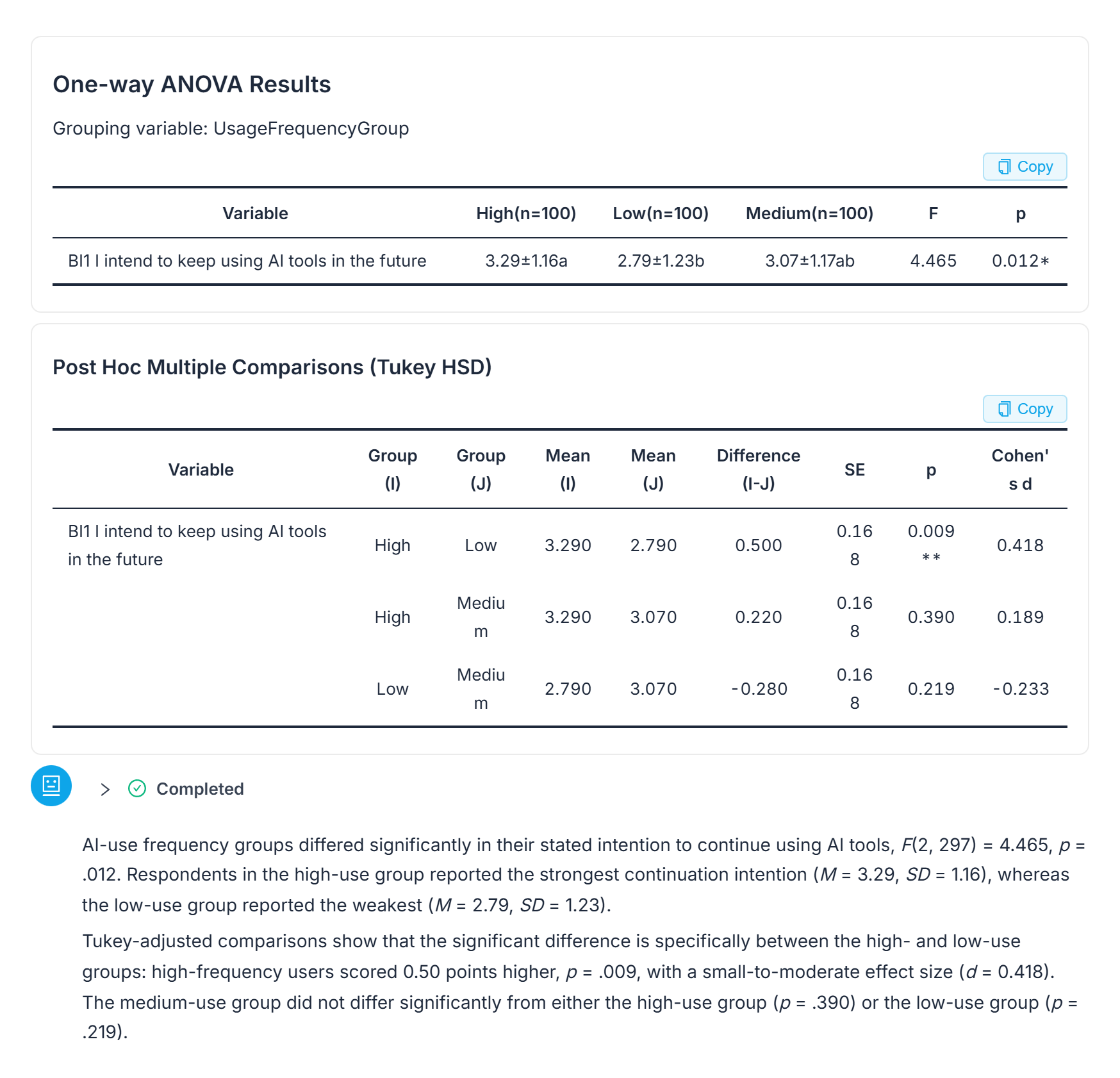 The output panel behind the tables above — omnibus F/p, group means, and the single significant Tukey pair are all visible in the same screenshot.
Only the High-vs-Low comparison clears p < .05; both comparisons involving the medium group do not. Applying the check recommended above for the current Tukey branch: recomputing I−J directly from the displayed means gives High − Low = 3.290 − 2.790 = 0.500, matching this table's own I−J column, so this particular row can be reported with direction. Cohen's d for that pair is not independently re-derived in this walkthrough; per the guidance above, treat it as unverified until it comes from a separately confirmed calculation, and leave it out of your own write-up until then.
A bounded sentence built only from the verified fields above:
AI-use frequency groups differed significantly in intention to continue using AI tools, F(2, 297) = 4.465, p = .012. The high-use group reported the strongest continuation intention (M = 3.29, SD = 1.16); the low-use group reported the weakest (M = 2.79, SD = 1.23). Tukey-adjusted comparisons located that difference specifically between the high- and low-use groups (adjusted p = .009); the medium-use group did not differ significantly from either the high-use group (p = .390) or the low-use group (p = .219).
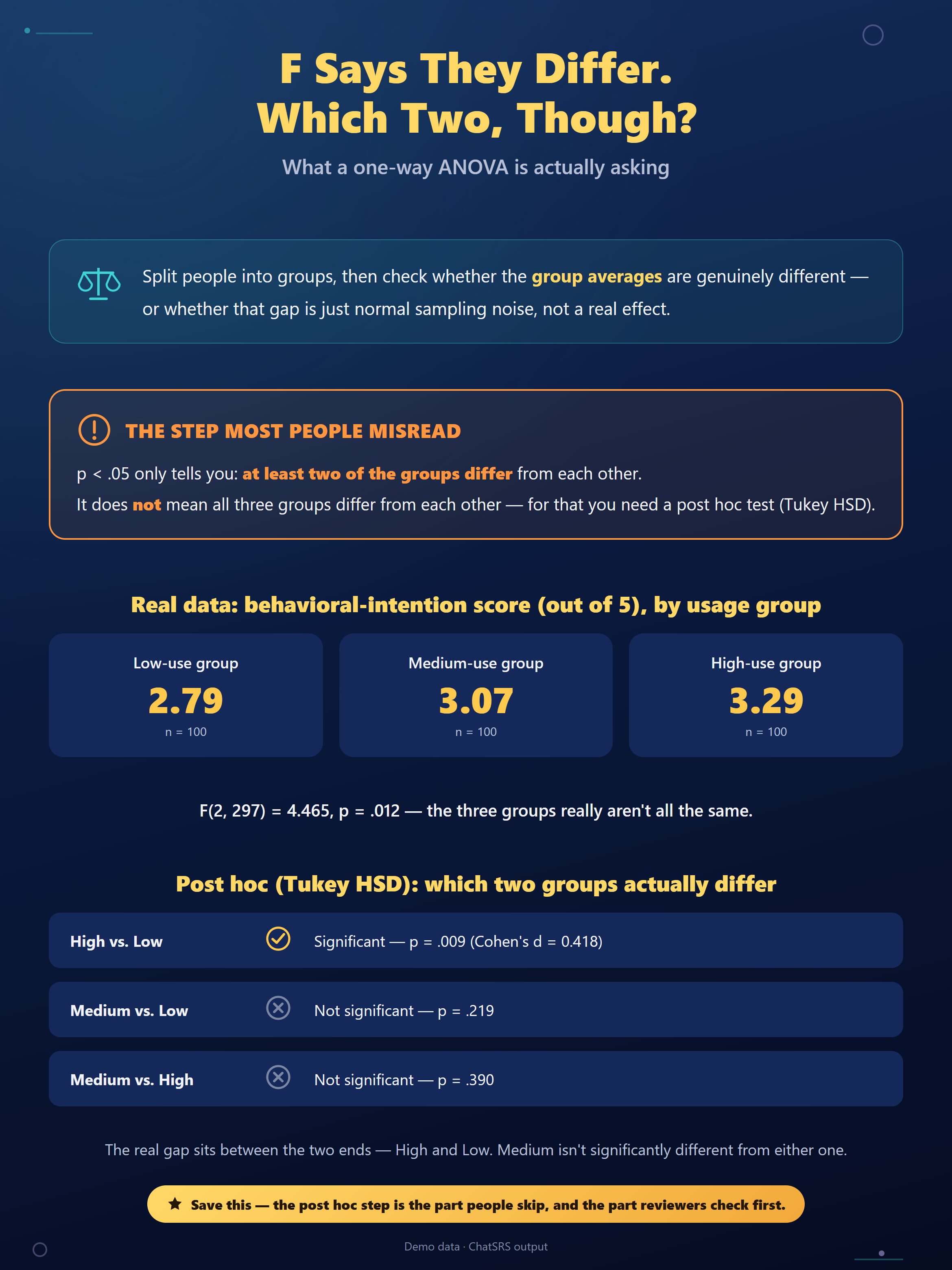 A map of the same "check F/p, then the means, then the post hoc table" path applied to the result above. For the run that produced this table, see Run ANOVA Online.
A complete APA-oriented paragraph template
Replace every bracket only from verified evidence:
A one-way between-groups ANOVA examined differences in [outcome, units] across [factor levels]. The analyzed sample comprised [verified effective N], with group summaries of [M and SD by group]. The omnibus result was [result], F([df1], [df2]) = [F], p [=/<] [p]. [Verified omnibus effect-size sentence, or omit until obtained.] [Named post hoc method] comparisons [summary tied to verified pair identity and p; for Tukey, include direction and d only after independent recomputation]. Independence and model assumptions were evaluated using [separate evidence]. Because the design was [randomized/observational], the result supports [bounded interpretation].
This is a reporting scaffold, not a guarantee of APA, journal, thesis, or instructor compliance. Check current APA Style and the target venue’s instructions.
Common errors to remove before submission
Omitting df
Report both df values with F. They identify the tested effect and error term.
Reporting p = .000
Use the actual bound or rounded nonzero value from the verified output; do not report a probability as exactly zero.
Adding eta squared because the template expects it
The current main table does not display it. Obtain a verified calculation or leave it out until available.
Reporting post hoc “significance” without a correction name
State LSD, Bonferroni, Tukey HSD, or the actual planned method and identify adjusted p values where applicable.
Reversing I−J
For LSD and Bonferroni, check the I/J order and sign for every pair. For the current Tukey branch, the renderer can place J−I and the corresponding d sign under an I−J label. Recompute I−J from the displayed means and verify d independently; otherwise omit direction, difference, and d from the prose.
Claiming all assumptions passed from the main table
The current table does not contain a complete assumption suite. Cite the separate diagnostic evidence.
Frequently asked questions
Must an ANOVA report include an effect size?
Many venues expect magnitude information, but requirements vary. Use an effect size appropriate to the design and obtain it from a verified source. The current ChatSRS one-way main table does not display an omnibus effect size.
Can I report Cohen’s d from the post hoc table as eta squared?
No. Pairwise Cohen’s d and an omnibus variance-explained effect size are different statistics.
Should I report every pairwise comparison?
Follow the prespecified comparison family and venue. Avoid hiding relevant null comparisons or listing unplanned tests selectively.
Can I copy the signed Tukey difference from the current table?
No. The current Tukey renderer can show J−I under an I−J label and applies the same sign direction to d. Use the pair and adjusted p, but independently recompute the signed difference and effect before writing a directional statement.
Does this template guarantee APA 7 compliance?
No. It keeps claims tied to statistical evidence, but current APA and venue requirements still require human review.
Reproducibility and related guides
Archive the design statement, data version, group map, missing-data record, exact analyzer request, main output, post hoc output, separate effect-size source, diagnostic evidence, extraction table, and final edits. For the execution path, read Run ANOVA Online. For table traceability, use APA Table Generator for Research Papers. For the broader archive, see AI Data Analysis for Academic Research.
Bottom line
Report the ANOVA that actually ran: design, group summaries, F, both df values, p, a verified effect size when available, and planned follow-up comparisons. For current Tukey output, do not treat the visible I−J or d sign as verified; recompute or omit those directional fields. Keep assumption evidence and provenance visible. Never let an APA template invent a statistic or overstate what the design supports.
Build an evidence-mapped ANOVA report in ChatSRS — verify every field before adapting it to your venue.