Statistical Tutorial ·
Run ANOVA Online: Assumptions, Post Hoc Tests and APA Output
Run a bounded one-way ANOVA online with verified group coding, assumptions, LSD/Bonferroni/Tukey choices, actual output fields, and an APA-oriented review workflow.
To run ANOVA online defensibly, first confirm that the data represent independent units, the outcome is appropriate for a classical one-way comparison, and the grouping variable encodes the prespecified groups. Then run the exact supported design, review missingness and assumptions outside the headline table, and request post hoc comparisons only under a justified plan. A formatted result is not evidence that every ANOVA design or assumption has been handled.
The current ChatSRS — AI Statistics anova analyzer implements a classical one-way between-groups ANOVA for one or more continuous outcomes and one grouping variable. It reports group mean ± SD, the omnibus F statistic and p value, and df1/df2 in a note. When post hoc testing is requested and the omnibus p value is below .05, it can run LSD, Bonferroni, or Tukey HSD comparisons. The comparison table displays group means, a labeled mean difference, standard error, p value, and Cohen’s d. In the current Tukey branch, however, the signed difference and d are stored as group J minus group I while the table labels the difference I−J. Treat both Tukey signs as unverified and recompute them from the displayed group means or another verified source. Confidence intervals, an omnibus effect size, Levene’s test, Welch ANOVA, and residual plots are not displayed by this analyzer.
First verify that one-way ANOVA is the design
The current path fits a question with:
- one categorical grouping variable with at least two independent groups;
- one or more continuous outcomes analyzed separately;
- one independent observational unit per row;
- a classical equal-variance one-way F test;
- no repeated observations, nesting, covariate adjustment, or factorial interaction in the same model.
If the same participants appear at several time points, use a repeated-measures or mixed workflow that represents dependence. If there are two factors and an interaction, use a multifactor design. If a baseline or another covariate must be adjusted, use an evidenced ANCOVA or regression workflow. If clustering or unequal variances drive the design, the classical table is not a substitute for a robust method.
A distinct working example
Suppose greenhouse_trays.csv contains one row per independently randomized tray. nutrient_plan has three levels—control, mineral, and compost—and leaf_area_cm2 is the prespecified outcome after four weeks. Each tray contributes one measurement. The protocol asks for a one-way comparison, followed by Tukey HSD only if the omnibus test supports planned pairwise follow-up.
A reproducible request is:
Audit
greenhouse_trays.csv. Confirm one row per uniquetray_id, verify the threenutrient_planlabels, inspect missingness and the distribution ofleaf_area_cm2within each group, and flag impossible values. If the independent one-way design is supported, run the current one-way ANOVA forleaf_area_cm2bynutrient_planwith Tukey post hoc comparisons requested. Report the group means and SDs, F, df1, df2, p, pair identity, standard error, and adjusted p value. Do not copy the visible Tukey I−J sign or Cohen’s d sign: independently recompute I−J from the displayed means and obtain d from a verified source before making a directional claim. If that verification is unavailable, report only the tested pair and adjusted p without higher/lower wording. Do not claim that the current table ran Levene’s test, Welch ANOVA, residual diagnostics, confidence intervals, or omnibus eta squared. Stop if tray independence or the prespecified grouping cannot be verified.
This request states the design and the unsupported fields instead of asking for generic “APA output.”
Audit the input before the F test
Unit of analysis
Confirm that a row is an independent tray, not an individual leaf or repeated measurement from the same tray. Inflating rows with subsamples can make standard errors too small and invalidate the test. If several leaves belong to one tray, aggregate or model the hierarchy according to the protocol rather than treating leaves as independent trays.
Group coding
List group labels, counts, and unexpected values. Similar labels such as Compost, compost , and comp can create accidental groups. Keep the reference source for treatment assignment and reconcile exclusions before analysis.
Outcome integrity
Check units, plausible range, missing codes, and whether the outcome was selected before seeing the result. Do not run many outcomes and report only the smallest p value without a multiplicity and reporting plan.
Per-outcome sample size
The current table header shows group counts from the loaded grouping data, while each outcome analysis removes rows missing that outcome. When outcomes have different missingness, do not assume the header count is the effective N for every F test. Read the missing-data notice and reconcile the complete observations for each outcome.
Assumptions require an evidence plan
Independence
Independence comes primarily from the design and data structure, not a diagnostic p value. Review randomization, repeated IDs, households, classrooms, sites, or other clusters. A one-way table cannot repair dependence.
Outcome distribution and residual behavior
ANOVA concerns model residuals, not a universal requirement that every raw group be perfectly normal. Inspect group distributions, residuals, influential observations, and sample sizes in context. Small groups can make violations harder to assess; large groups can make minor departures easy to flag. Do not delete observations simply to pass a test.
Variance structure
Classical one-way ANOVA uses a pooled within-group variance. Review group SDs, plots, sample-size imbalance, and a prespecified variance assessment. The current anova output does not display Levene’s test or a Welch alternative. If unequal variance is material, use and document a verified method that represents it rather than relabeling the classical F test.
Measurement and group definition
The outcome should have a meaningful scale for mean comparison, and groups must correspond to the design. Numeric storage of an ordinal item does not automatically justify treating it as continuous.
What the current output actually contains
For each selected outcome, the main Markdown table includes:
- one column per group with mean ± SD;
- group counts in the group-column headers;
- the omnibus F statistic;
- the formatted p value;
- df1 and df2 in the table note.
If post hoc testing was requested and the omnibus p is below .05, the tool adds letter marks to group summaries and renders a pairwise table. That table contains group I and J, their means, a difference labeled I−J, standard error, p value, and Cohen’s d. The LSD and Bonferroni branches calculate the signed difference as I−J. The current Tukey branch instead passes the statsmodels meandiff value, defined as group J minus group I, into the I−J-labeled column and uses the same reversed sign for d. For example, if I = A has mean 1 and J = B has mean 3, the true I−J is −2, but the current Tukey row may display +2 and a positive d. The pair identity and Tukey-adjusted p value remain usable; the signed difference and d must be independently recomputed before directional reporting. Tukey confidence bounds are calculated internally but are not included in the current Markdown table, so do not claim that the visible result supplies them.
If the omnibus result is not below .05, the current analyzer does not render the requested post hoc table. That behavior should be recorded rather than described as a software failure.
Choose post hoc tests before reading the winner
Tukey HSD
Tukey is designed for all pairwise comparisons under the corresponding classical assumptions. It is a common fit when every group pair is of interest. The current implementation uses statsmodels and displays adjusted p values. Because its visible I−J label conflicts with the stored J−I sign, do not interpret the displayed Tukey difference or d sign until each has been independently recomputed.
Bonferroni
The current Bonferroni path multiplies raw pairwise p values by the number of pairwise comparisons, capped at 1. It can be conservative, especially with many groups. Use it because it matches the planned comparison family, not because it gives a preferred answer.
LSD
The current LSD path uses the pooled ANOVA error term and unadjusted pairwise p values. It offers weaker multiplicity control than Tukey or Bonferroni. Do not choose it after seeing that adjusted results are nonsignificant.
Planned contrasts are not the same as an all-pairs post hoc table. If the protocol specifies a particular contrast, use an implementation that directly represents it.
Read results in the correct order
For the greenhouse example:
- reconcile tray IDs, group labels, exclusions, and outcome units;
- review group counts, means, SDs, and missingness;
- confirm that the F degrees of freedom match the number of groups and effective sample;
- interpret the omnibus p value as evidence about at least one group mean difference under the model;
- review only the planned post hoc family;
- for LSD or Bonferroni, verify I−J against the group order; for Tukey, ignore the visible signed difference and recompute I−J from the displayed means;
- for Tukey, obtain a separately verified signed Cohen’s d before interpreting direction; otherwise report the pair and adjusted p only;
- disclose assumption checks performed outside the current table;
- avoid causal language unless the design supports it.
An illustrative result such as F(2, 87) = 5.42, p = .006 is not a live result. It cannot be used until the data, model, df, and output are verified.
A worked run: from plain-English prompt to omnibus table
Here is what that review order looks like on a real run — simulated survey data (N = 300), split into low/medium/high AI-tool usage-frequency groups, 100 per group. This is demo data, not a live analysis for this article.
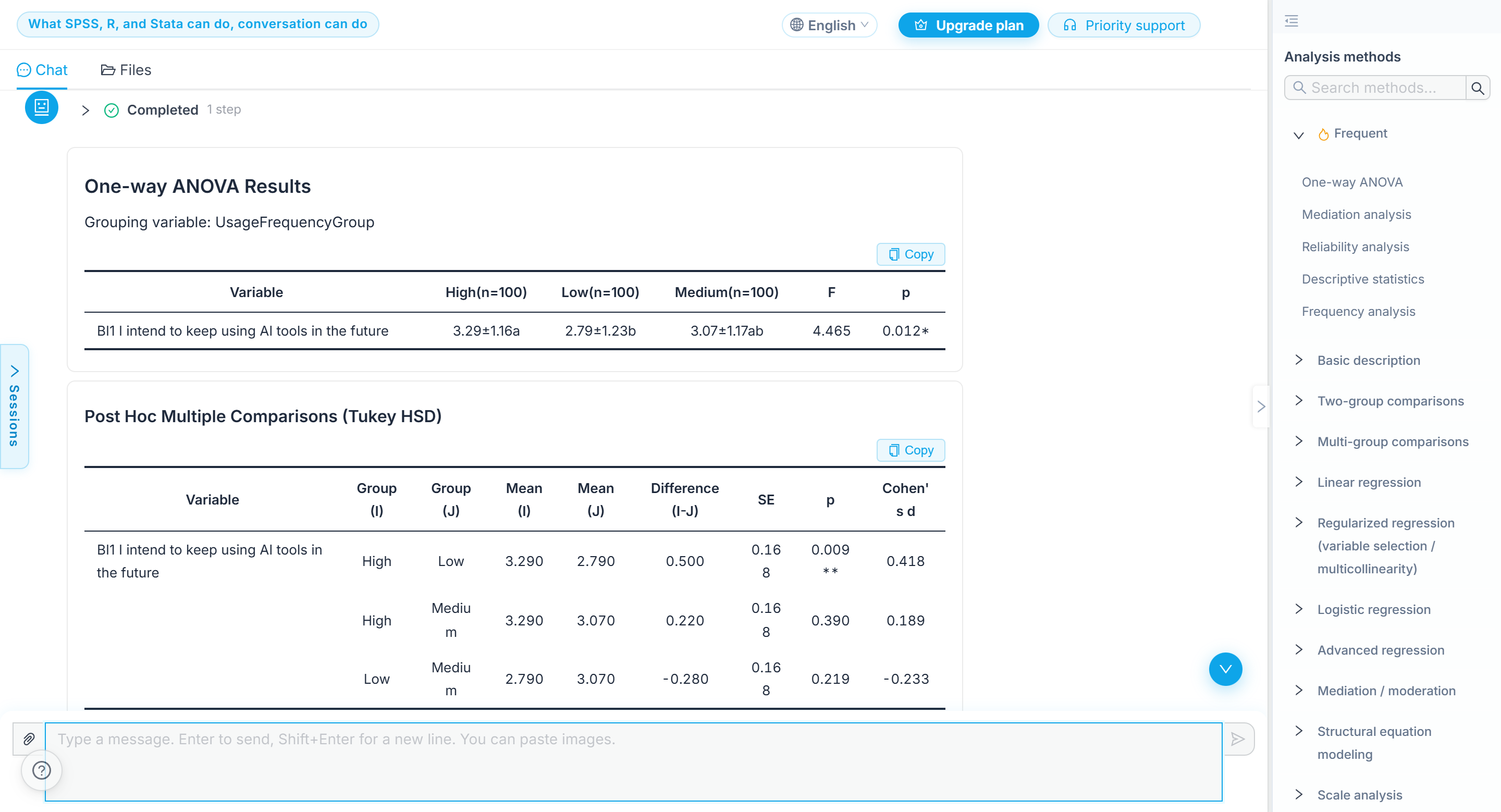 The chat interface behind the run below.
The request was one plain-English line: "Group these by usage frequency and check whether the three groups differ in behavioral intention (BI)."
 The one-line request that produced the omnibus and post hoc tables below.
Grouping variable: UsageFrequencyGroup
| Variable | High (n=100) | Low (n=100) | Medium (n=100) | F | p |
|---|---|---|---|---|---|
| BI1 — I intend to keep using AI tools in the future | 3.29±1.16a | 2.79±1.23b | 3.07±1.17ab | 4.465 | .012* |
Post hoc (Tukey HSD):
| Group (I) | Group (J) | Mean (I) | Mean (J) | Difference (I−J) | SE | p | Cohen's d |
|---|---|---|---|---|---|---|---|
| High | Low | 3.290 | 2.790 | 0.500 | 0.168 | .009** | 0.418 |
| High | Medium | 3.290 | 3.070 | 0.220 | 0.168 | .390 | 0.189 |
| Low | Medium | 2.790 | 3.070 | -0.280 | 0.168 | .219 | -0.233 |
Source: ChatSRS one-way ANOVA output on simulated survey data, N = 300, grouping variable UsageFrequencyGroup (chatsrs-en-results.md, 04-anova run).
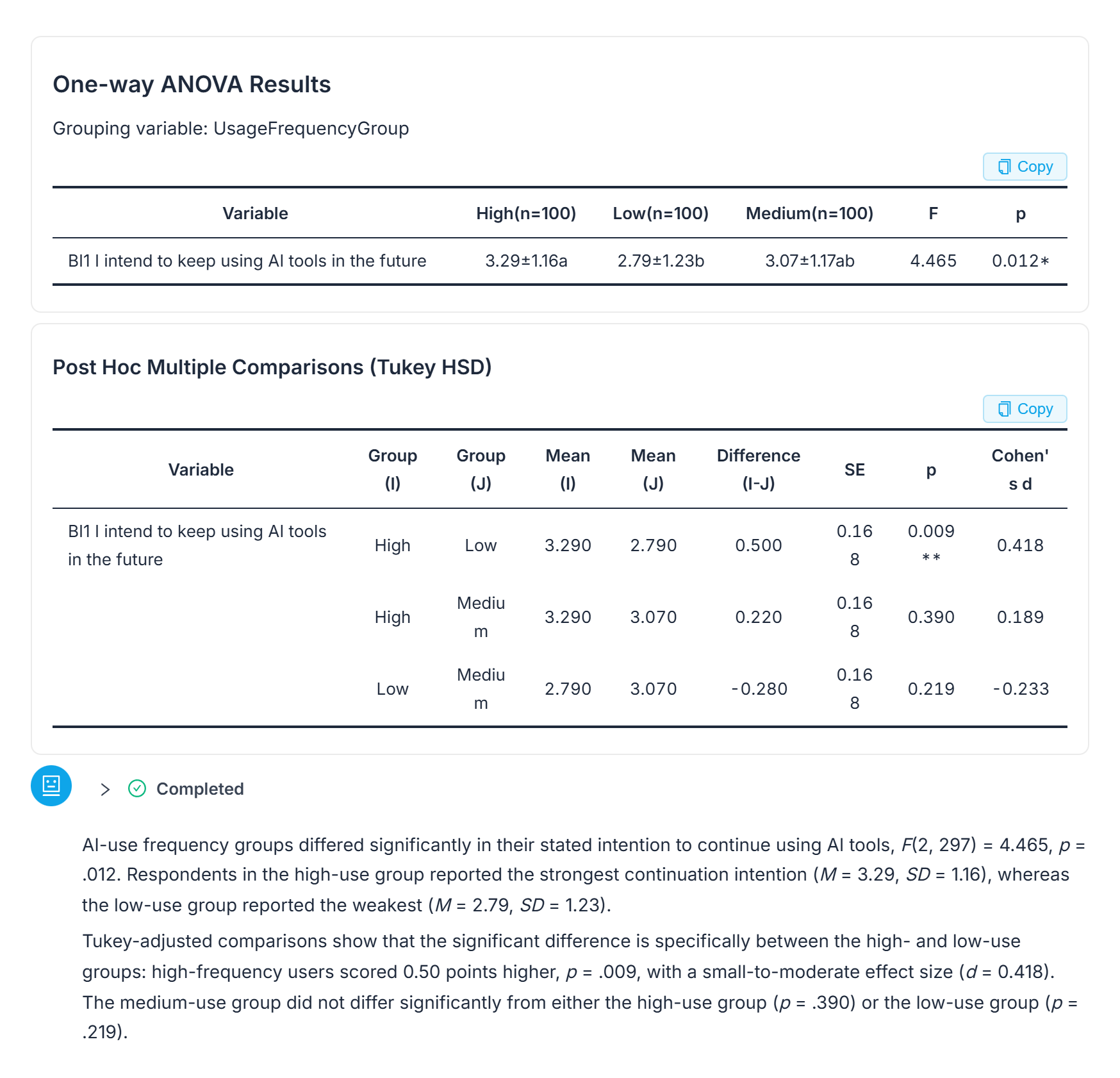 The output panel behind the tables above — omnibus F/p and the single significant Tukey pair are both visible in the same screenshot.
Following the review order above: the omnibus result is significant, F(2, 297) = 4.465, p = .012, so at least two of the three groups differ. In the post hoc table, only the High-vs-Low row clears .05 (p = .009); High-vs-Medium (p = .390) and Low-vs-Medium (p = .219) do not. Independently recomputing the signed difference from the displayed group means, as this guide recommends for the current Tukey branch, gives High − Low = 3.290 − 2.790 = 0.500 — matching the table's own I−J column on this pair. Cohen's d for that row is not re-derived here; treat it the same way the assumptions above do, and obtain it from a separately verified source before writing a directional effect-size claim of your own.
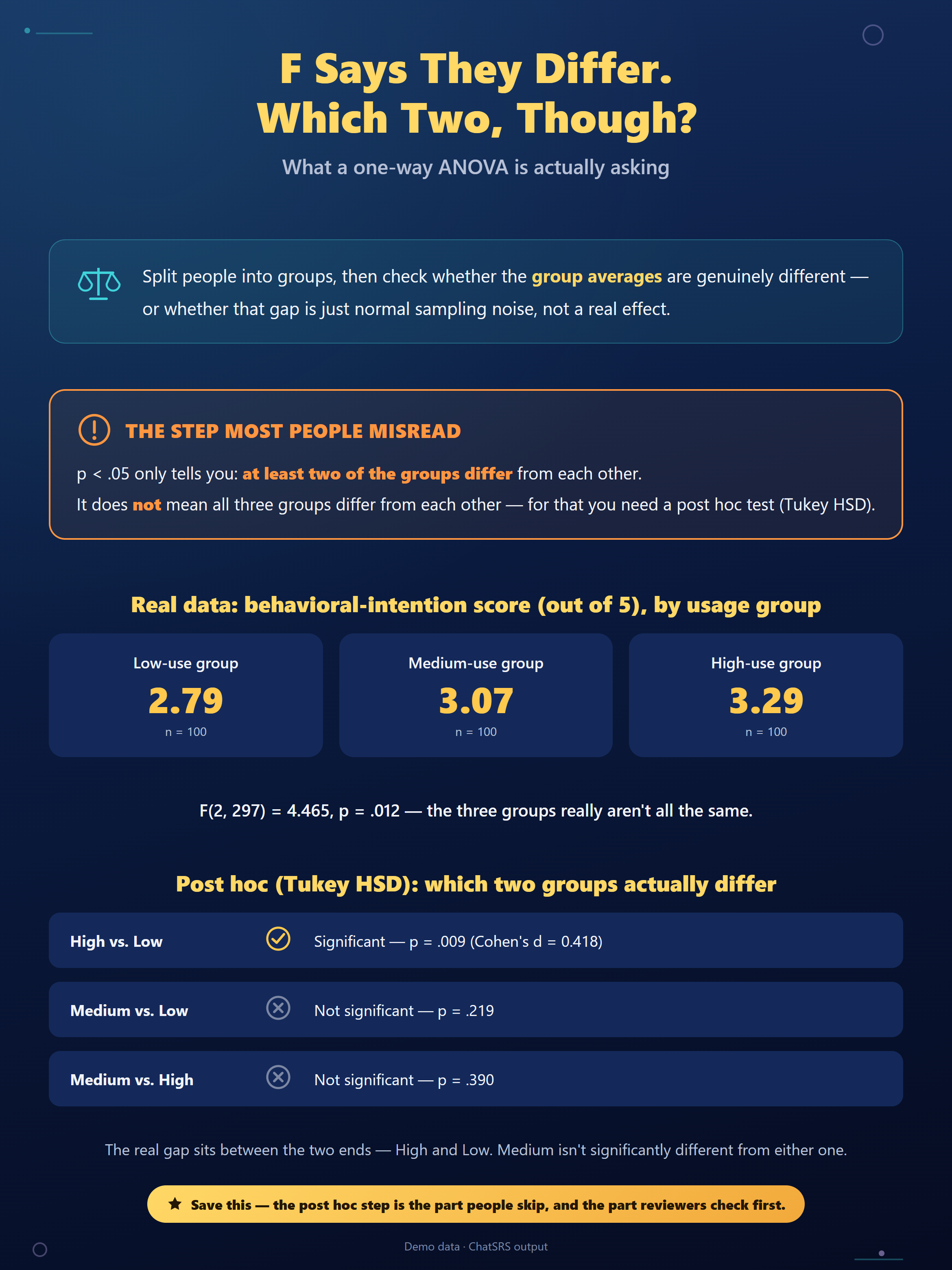 A map of the same "check F/p, then the means, then the post hoc table" path applied to the result above. For the full walkthrough of turning this into an APA write-up, see How to Report ANOVA in APA 7.
APA-oriented output without invented fields
A bounded draft might read:
A one-way analysis of variance compared four-week leaf area across the control, mineral, and compost groups. Group means and standard deviations were reviewed before inference. The omnibus comparison was [significant/not significant], F([verified df1], [verified df2]) = [verified F], p = [verified p]. [If rendered and planned: Tukey-adjusted comparisons tested [verified pair] (adjusted p = [verified p]). Direction and Cohen’s d were reported only after an independent calculation confirmed I−J from the displayed group means and verified the signed effect size.] Assumption and independence checks were evaluated separately because they are not contained in the current ANOVA table.
Do not add eta squared, confidence intervals, Levene statistics, or Welch results unless a verified output source provides them. For a dedicated reporting checklist, see How to Report ANOVA in APA 7.
Common failure modes
Calling every group comparison “one-way ANOVA”
Repeated, factorial, adjusted, nested, and clustered designs require different models.
Running post hoc tests because the omnibus result is significant
Significance does not define the comparison family. The family and correction should come from the question and plan.
Claiming the current output checked all assumptions
It does not display Levene’s test, residual plots, or Welch ANOVA. Keep those checks in a separate evidence record.
Reporting group-header N as every outcome’s effective N
Outcome-specific missingness can reduce the analyzed observations. Reconcile the missing-data notice and df.
Inventing an omnibus effect size
The current main table does not display eta squared or omega squared. Use a verified source if the report requires one.
Copying the visible Tukey I−J sign
The current Tukey renderer can show J−I under an I−J label and can give d the same reversed sign. Recompute the signed difference from the displayed group means and verify d independently; if you cannot, report the pair and adjusted p without directional wording.
Frequently asked questions
Can I use this ANOVA for repeated measurements?
No. The current anova path is a one-way between-groups analysis. Repeated observations require a repeated-measures or mixed method that represents within-unit dependence.
Which post hoc methods are currently supported?
LSD, Bonferroni, and Tukey HSD. The post hoc table is rendered only when requested and the omnibus p value is below .05. For the current Tukey branch, the pair and adjusted p are usable, but the displayed difference and d signs require independent recomputation because the visible I−J label conflicts with the stored J−I direction.
Does the current table report eta squared?
No. It reports F, p, df in a note, group summaries, and—when rendered—pairwise fields including Cohen’s d. Obtain an omnibus effect size from a separately verified method when required.
Does an online result guarantee APA compliance?
No. Verify every value and adapt the confirmed result to current APA and venue requirements. The analytical output is evidence, not automatic acceptance.
Reproducibility package
Archive the raw file checksum, unit-of-analysis check, group map, exclusions, outcome definitions, exact request, post hoc choice and rationale, missing-data notice, main table, pairwise table, external assumption evidence, software/analyzer identity, and edited report. For a broader archive workflow, read AI Data Analysis for Academic Research. For traceable table construction, see APA Table Generator for Research Papers.
Bottom line
Use the current online ANOVA path for a verified one-way independent-groups design. Review assumptions separately, choose LSD/Bonferroni/Tukey from the planned comparison family, and report only verified fields. For Tukey, independently recompute the signed difference and d rather than trusting the visible I−J sign. Stop or switch methods when dependence, variance structure, covariates, or factorial questions exceed that design.
Run a bounded one-way ANOVA workflow in ChatSRS — bring the unit-of-analysis rule, group map, outcome definition, and post hoc plan.