Academic Reporting ·
How to Read and Report Mediation Analysis Results: Indirect Effect, Direct Effect and CI
How to read a mediation analysis output and write it up in APA style: the indirect effect, the direct effect, the bootstrap CI, and how to tell partial from full mediation, with a full worked example.
Reading a mediation analysis output comes down to two checks: does the bootstrap 95% CI for the indirect effect (a × b) exclude zero, and is the direct effect (c′) still significant once the mediator is in the model? Those two answers tell you whether mediation held, and whether it was partial or full mediation. Below is a full worked example.
What This Guide Covers
This is the results-reading companion to running a mediation analysis — same simulated survey data (N = 300), same PU → ATT → BI path, whether it ran in SPSS, Stata, R, or a PROCESS-style bootstrap. This page is about what to do with the table once it's in front of you.
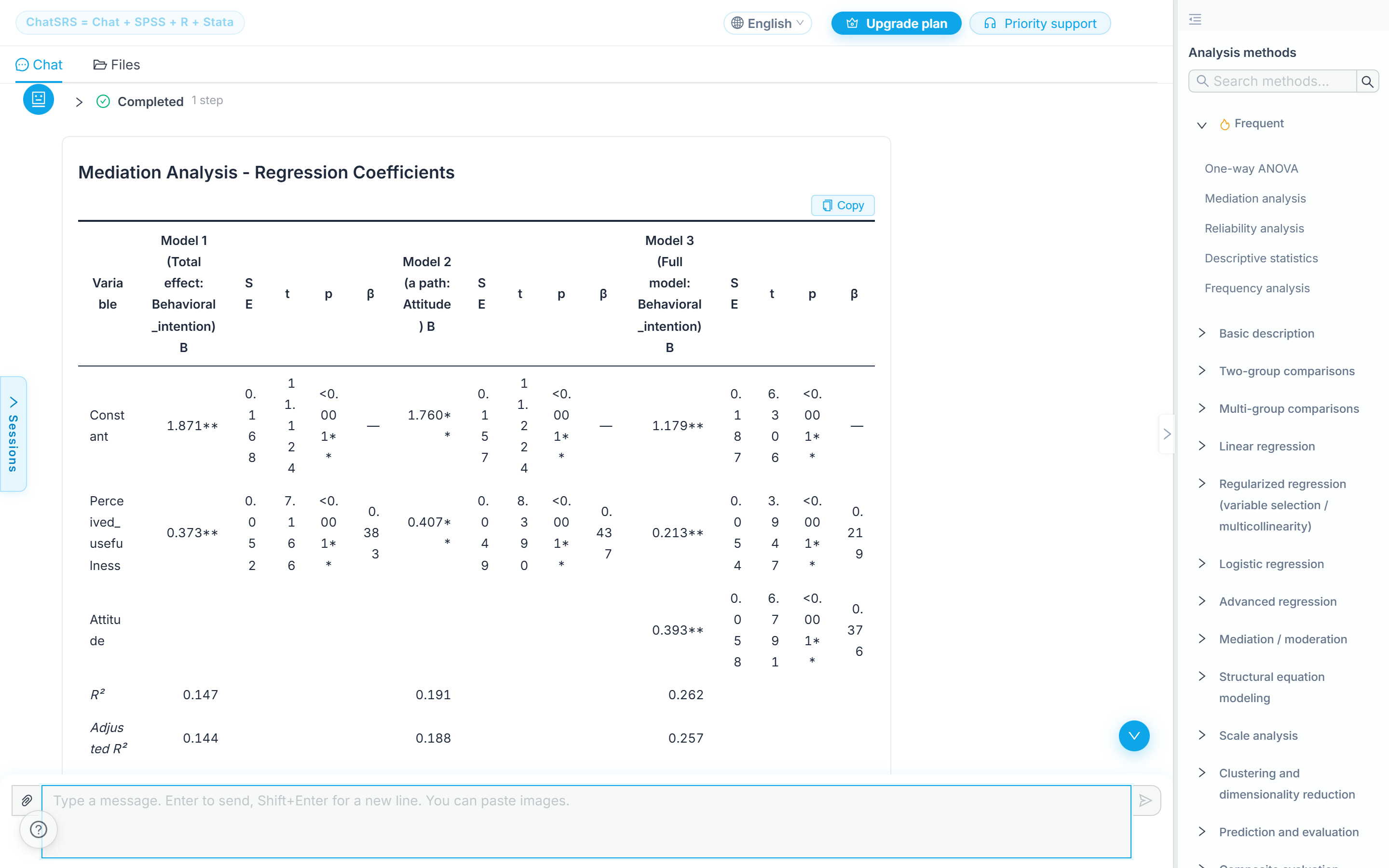 The interface this example was run in: the header states that what SPSS, R, and Stata can do, conversation can do too, and the chat input at the bottom is where the mediation request was typed.
How Do You Read the Indirect Effect (a × b) and Its Confidence Interval?
Start with the indirect effect — the mediated path, a × b. In this example it's 0.159, bootstrap SE = 0.030, 95% bootstrap CI = [0.105, 0.221] (z = 5.328, p < .001). The interval doesn't cross zero, so the effect is significant — no p-value needed, the CI is the test. The full table below also breaks that number into its two components, path a (PU → ATT) and path b (ATT → BI).
Is the Direct Effect Also Significant? Partial vs Full Mediation
Next, the direct effect c′ — PU's effect on BI, controlling for ATT — is also significant (0.213, p < .001). Both effects being significant is what tells you ATT only partly explains the PU → BI relationship: PU keeps a direct path of its own. That's "partial mediation" (a non-significant c′ would instead mean full mediation).
| Path | B | SE | t / z | p | 95% Bootstrap CI |
|---|---|---|---|---|---|
| Total effect (c): PU → BI | 0.373 | 0.052 | t = 7.166 | < .001 | — |
| Path a: PU → ATT | 0.407 | 0.049 | t = 8.390 | < .001 | — |
| Path b: ATT → BI (PU held constant) | 0.393 | 0.058 | t = 6.791 | < .001 | — |
| Direct effect (c′): PU → BI (ATT held constant) | 0.213 | 0.054 | t = 3.947 | < .001 | — |
| Indirect effect (a × b) | 0.159 | 0.030 (bootstrap SE) | z = 5.328 | < .001 | [0.105, 0.221] |
Full model: R² = .262, adjusted R² = .257, F(2, 297) = 52.624, p < .001. Mediation type: partial mediation. Simulated survey data, N = 300, PU → ATT → BI path, 1,000 bootstrap resamples. Source: ChatSRS mediation analysis output.
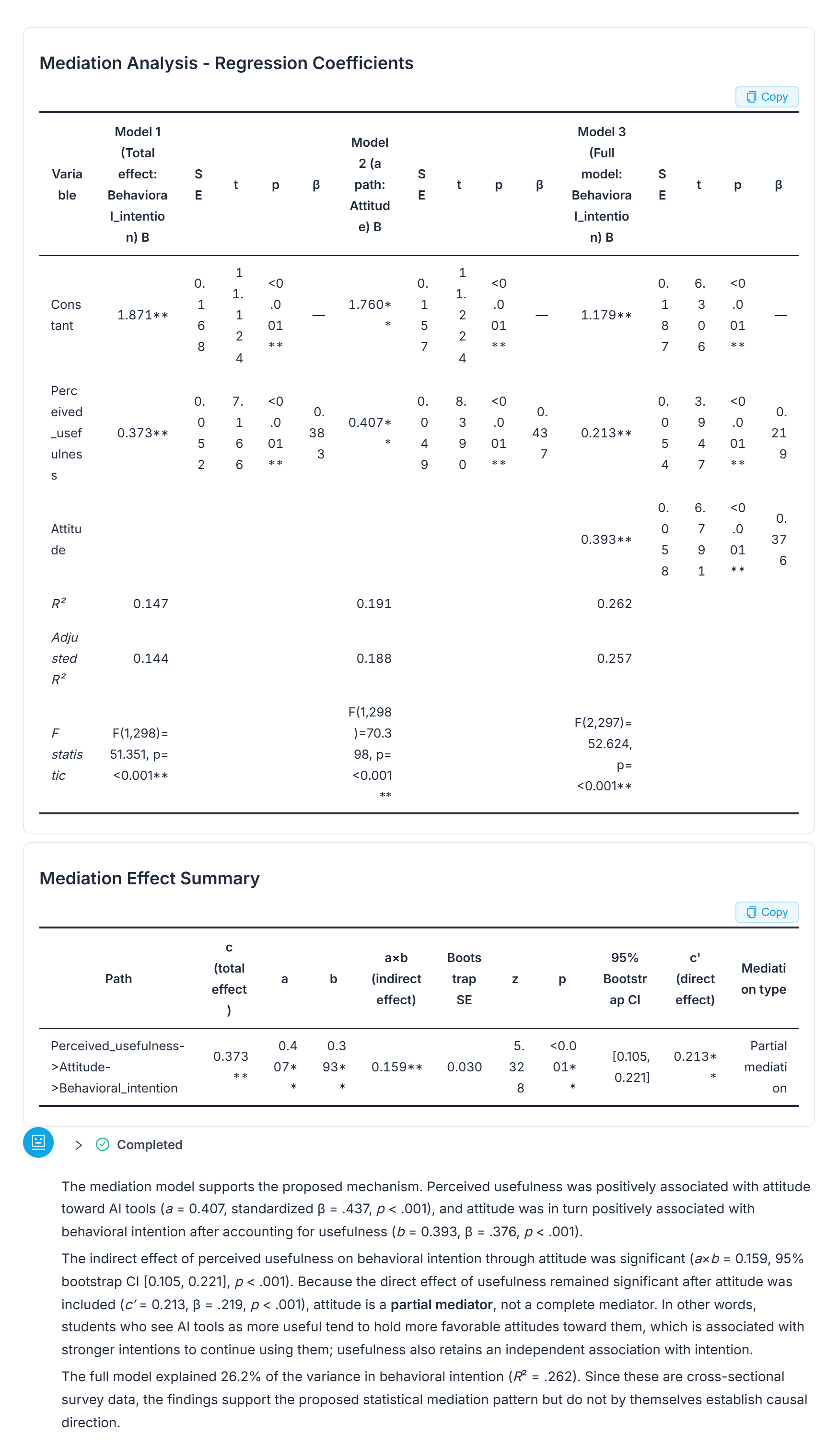 The full output, with the indirect effect and its CI highlighted — the AI's interpretation text doubles as a ready template for the write-up.
How Do You Report Mediation Analysis Results in APA Style?
Language you can lift and adapt:
"Using bootstrapping (1,000 resamples), we tested whether M mediated the effect of X on Y. The indirect effect was a × b (95% CI excluding zero), indicating a significant mediation effect. The direct effect c′ was also significant (p < .05), suggesting that M partially mediates the X → Y relationship."
Filled in: X = perceived usefulness (PU), M = attitude (ATT), Y = behavioral intention (BI), indirect effect = 0.159 (95% CI [0.105, 0.221]), direct effect c′ = 0.213 (p < .001) — ATT partially mediates the PU → BI relationship.
What Does the Decision Path Look Like?
Indirect effect significant → direct effect significant → partial or full mediation. Worth saving as a reference image.
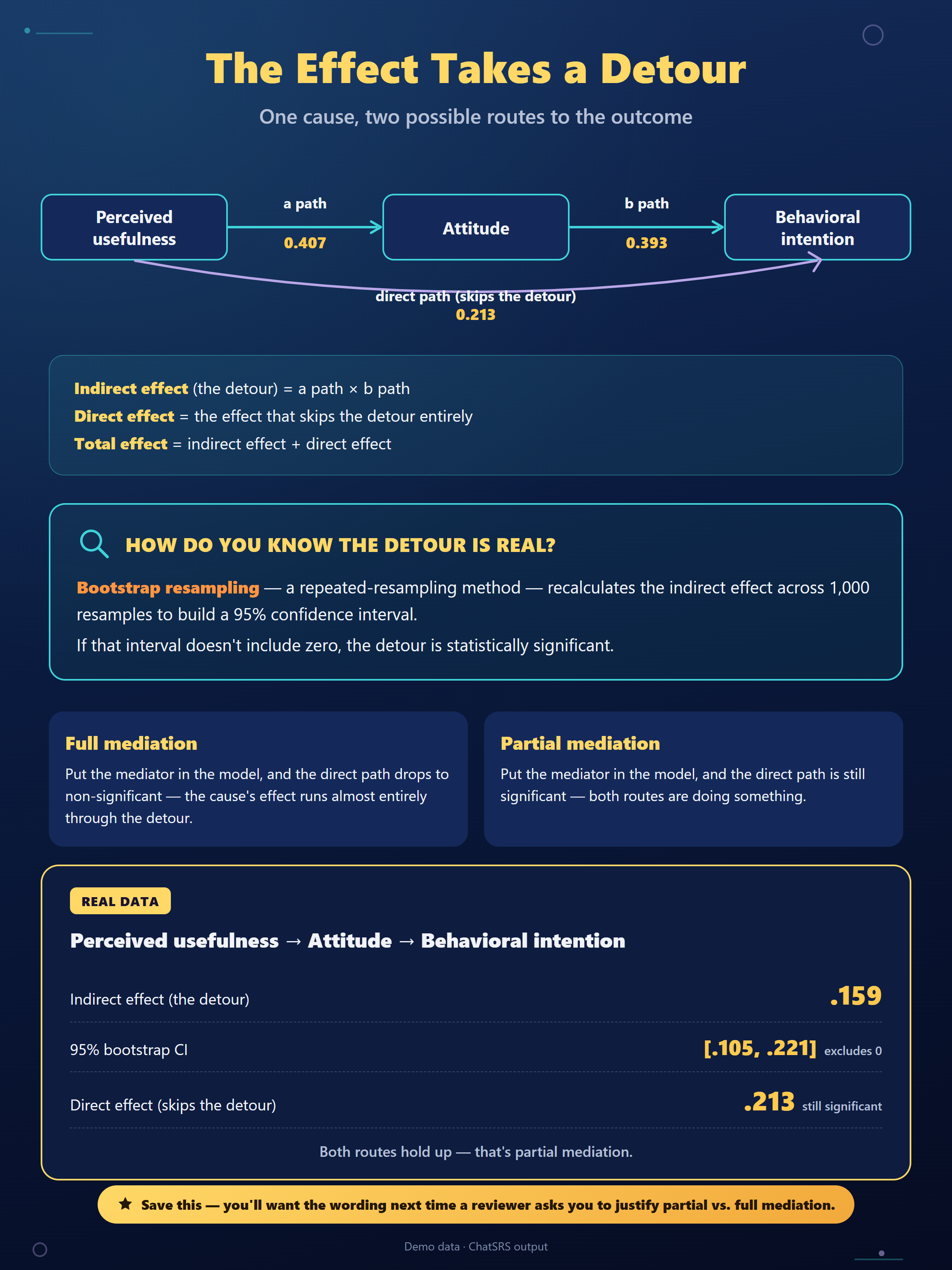 The decision path in one image, illustrated with this example's own numbers (indirect effect = 0.159, direct effect = 0.213).
When Does This Not Apply?
Mediation analysis assumes a theoretically justified causal order going in — PU leads to ATT leads to BI, not some other order. What comes out is a statistical result, not proof of that causal story; that argument comes from your research design and field theory, not the regression output.
This guide covers a single-mediator bootstrap model like the one above; multiple mediators in sequence, or a mediation moderated by a third variable, need a different reporting template.
Frequently Asked Questions
Do I need a p-value to know if my indirect effect is significant?
No. For a bootstrapped indirect effect, the 95% CI is the test: if it excludes zero, the effect is significant, no separate p-value required. Here, [0.105, 0.221] excludes zero.
What's the difference between partial and full mediation?
Both hinge on c′ once the indirect effect is already significant. Significant c′ = partial mediation (the mediator explains part, not all, of the relationship). Non-significant c′ = full mediation. Here, both the indirect effect (0.159) and c′ (0.213) are significant, so it's partial.
Can I calculate what percentage of the total effect is mediated?
Only if your own output actually reports that ratio. If yours doesn't include a "percent mediated" column, don't divide the indirect effect by the total effect yourself and present that as a finding — a derived number isn't the same as an output number. Report the indirect and total effects as separate, sourced figures instead.
How many bootstrap resamples should I use?
Whatever you actually ran — report that exact number alongside the CI (this example used 1,000). Conventions vary by field and advisor; confirm the expected number before running the analysis, not after.
Related Reading
To turn a table like this into a clean APA table, see the APA table generator for research papers. For F, df, and p reporting mechanics in a comparable design, see how to report ANOVA in APA 7. Haven't run the model yet? Start with the mediation analysis walkthrough.
Bottom Line
Reading a mediation result is a two-step check — indirect effect CI, then direct effect significance — and reporting it is mostly citing the right numbers from that table, not deriving new ones.
Read your own mediation analysis output in ChatSRS — check the indirect effect's CI, the direct effect's significance, and get an interpretation you can adapt into your results section.